StopReg Review: Disposable Email & Signup Abuse Detection API (2026)
StopReg is a real-time email intelligence API for blocking disposable, relay/alias, role-based, and risky signups. Our review covers dual endpoints, pricing…

Reviewing StopReg · Published · 15 min read
Opening
You launch a free trial. Overnight, fifty accounts appear. Half never open the product. A third bounce on first nurture. The rest came from throwaway inboxes, Apple Hide My Email relays, or admin@ aliases that look valid to a regex and worthless to a sales team.
That is the problem StopReg is built to solve. StopReg is a real-time email intelligence API that classifies disposable, fake, and risky addresses in a single request—so signup, lead, and trial forms can block, allow, or flag before the account exists.
On Launchpadly, StopReg lists under SaaS (Node.js, MongoDB), with the tagline Trust Every Signup. It launched on the board on 2026-08-06 and sits in the homepage Featured & Premium band as ★ Premium. This review is based on StopReg’s live production site, FAQ, pricing table, and that listing—not a paid penetration test or multi-week production soak.
Disclosure: Independent Launchpadly editorial—not a sponsored endorsement. Pricing, request quotas, and detection coverage can change; confirm on stopreg.com before you buy.
Key takeaways
- StopReg targets signup abuse—disposable/throwaway domains, relay/alias services (including Apple Hide My Email and Firefox Relay per FAQ), role-based mailboxes, and related risk signals—more than inboxing or campaign deliverability.
- You get two REST endpoints: full email validation, and a domain-only path that avoids transmitting the full address (privacy-first / data-minimization positioning).
- Checks include disposable detection (auto-updated DEA database), role-based detection, public providers (Gmail/Yahoo/Outlook), syntax validation, MX verification, and forwarding/alias/relay detection.
- FAQ cites typical responses under 500ms; homepage positions responses in milliseconds with JSON payloads.
- Pricing as published August 2026: free 200 requests/month (no credit card); paid tiers from Launch $20/mo (60k) through Elite $400/mo (2.8M); Enterprise custom with SLA.
- Strong fit for SaaS, marketplaces, and form abuse; weaker fit if you need a full deliverability suite like Kickbox, ZeroBounce, or NeverBounce.
What is StopReg?
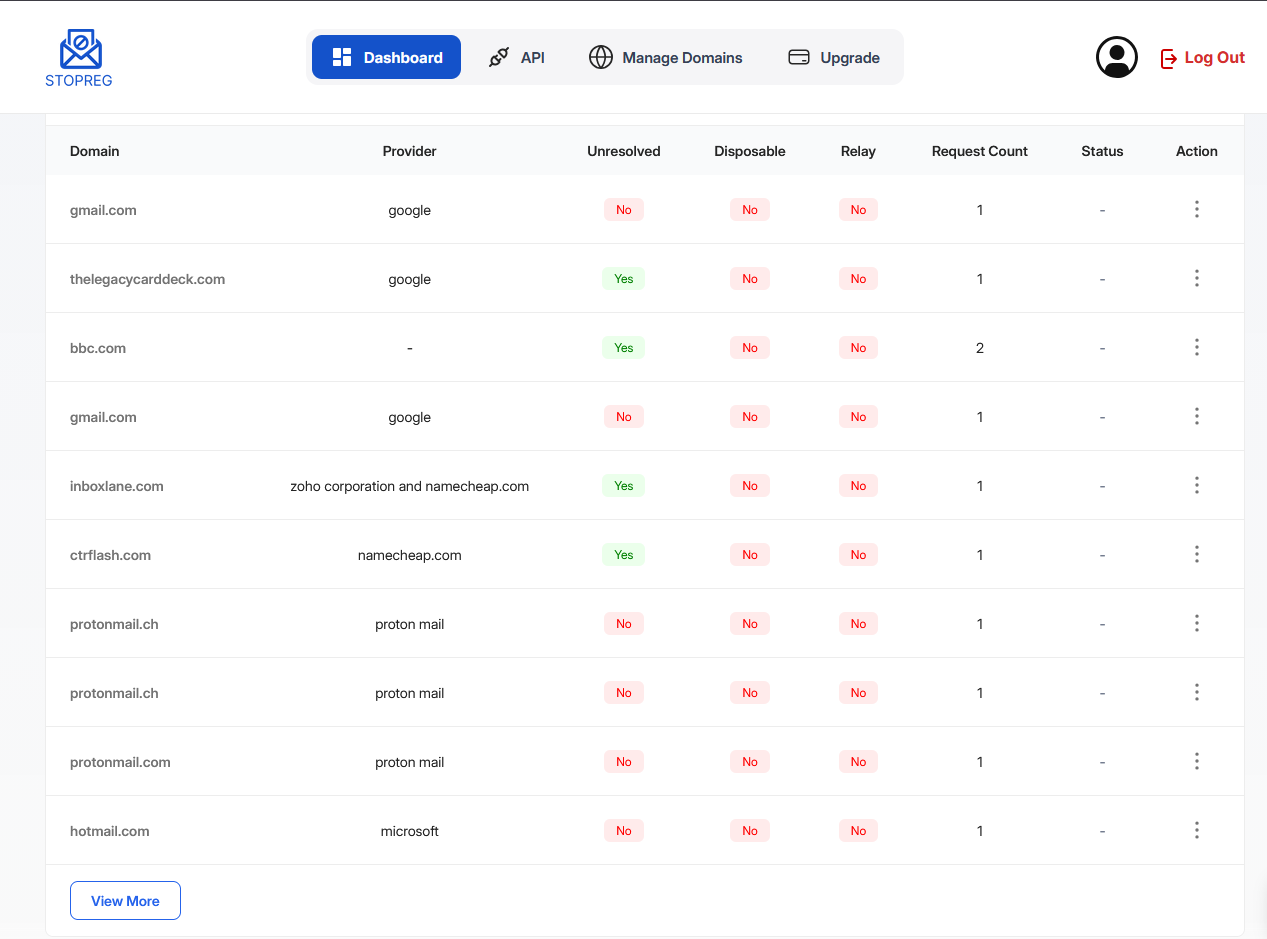
StopReg is an email validation and signup-filtering API. You send an email (or domain) to api.stopreg.com, authenticate with an API token, and receive a JSON classification you can use to block disposable inboxes, flag relays, or segment free-provider signups.
The product homepage frames the outcome plainly: block fake signups; grow with real users. The vendor’s FAQ describes StopReg as an email intelligence and validation platform for detecting fake signups, disposable emails, and relay/alias addresses in real time.
Technically, the public surface is a developer REST API with:
- Full email validation endpoint
- Domain-only validation endpoint
- Example clients for Node.js, cURL, Python, PHP, Go, Java, and C#
- Integration callouts for Laravel, HTTP API, PHP, JavaScript, and NPM
- Dashboard access after account creation (API keys, seats, logs)
Stack on the Launchpadly listing: Node.js and MongoDB. Category: SaaS.
StopReg is not pitching itself as an ESP replacement, a warm-up tool, or a bounce-rate dashboard for outbound campaigns. Its center of gravity is registration quality—who gets through your form—and the privacy story around how much of that address you need to transmit.
Evaluation methodology
We reviewed:
- Live homepage, feature copy, pricing table, and FAQ on stopreg.com
- Public API example patterns on the site (token header, verify path)
- The Launchpadly StopReg listing (slug
stopreg, Premium placement, listed 2026-08-06)
We did not run a paid production workload, independent DEA accuracy benchmark, or formal GDPR audit. Latency claims below are vendor FAQ statements (“typically under 500ms”), not our stopwatch results. Competitor contrasts describe positioning differences; list prices and feature matrices at Kickbox, ZeroBounce, NeverBounce, Clearout, and Abstract API change—validate against your own quotes.
Product overview
The signup problem StopReg addresses
Disposable email address (DEA) services and privacy relays make it trivial to create accounts without a durable identity. That shows up as:
- Burned free-trial seats
- Inflated funnel metrics
- Support load from users you cannot recontact
- Abuse of invite, credit, or referral programs
StopReg’s checks map to those failure modes: disposable domains, relay/alias providers, role-based addresses that often signal shared or non-personal inboxes, and MX/syntax sanity so obviously invalid strings never become users.
Two API endpoints
StopReg’s dual-endpoint design is the clearest product decision on the site.
Full email validation API — Sends the complete address. Runs disposable detection, role-based checks, public provider identification, syntax validation, and MX verification. Positioned for user registrations and lead forms where you already collect the email.
Domain-only API (privacy-first) — Validates without transmitting the full email address. Performs disposable detection, public provider identification, and MX verification. Positioned for privacy-focused platforms and regulated environments.
If your compliance team wants data minimization, domain-only is the feature to evaluate first: you still get risk signals on the domain without shipping the local-part to StopReg’s API on every request.
How a request flows
Per the vendor’s published flow:
- Sign up and open the dashboard
- Choose full email or domain-only endpoint
- Submit email or domain
- Real-time validation (milliseconds)
- Receive a JSON response with validation results
Authentication in the published Node example uses an x-api-token header against a path like /api/v1/verify/email/{email} on https://api.stopreg.com.
Classification you can act on
The FAQ lists clear categories for real-time signup decisions:
- Disposable
- Relay
- Free email provider
- Alias
- Role-based email address
Your app then blocks, allows, or flags for review. That three-way policy is important: not every free Gmail signup is abuse, but every Guerrillamail-style DEA usually is. StopReg’s job is classification; policy remains yours.
Key features
Disposable email detection
StopReg detects temporary and throwaway addresses used to abuse signups and free trials, backed by an auto-updated DEA database. Continuously refreshed DEA coverage is table stakes in this category—new throwaway domains appear constantly—so the “auto-updated” claim is central to whether the API stays useful after month one. Confirm freshness expectations with support if you run a high-abuse consumer funnel.
Role-based detection
Identifies non-personal addresses such as admin@, support@, info@, and sales@. Useful when you want real individual engagement (B2B trials, community products) and prefer not to treat shared mailboxes as primary users.
Public email provider detection
Flags providers like Gmail, Yahoo, Outlook, and similar. This is segmentation more than hard blocking—many products allow free providers but route them differently for sales scoring or freemium limits.
Syntax validation
Confirms the address follows formatting rules before deeper processing. Cheap early reject for typos and garbage strings.
MX record verification
Checks whether the domain has valid MX records and can receive mail. Catches domains that look plausible but cannot accept email—common in bot and scripted signup noise.
Email forwarding / alias / relay detection
Detects domains that forward mail, including relay or alias providers often abused for signups. The FAQ explicitly names Apple Hide My Email and Firefox Relay. This is a sharper wedge than generic “is this deliverable?” APIs: privacy relays are legitimate for users and painful for free-trial abuse. Treat relay policy carefully—blanket blocking can reject privacy-conscious real customers; many teams flag relays instead of hard-blocking.
Bulk validation
Paid plans include bulk email & domain validation—useful for cleaning existing lists or batch-screening imports, not only live form hooks.
Custom blocklist / allowlist
Lets you encode business-specific rules (always allow partner domains; always block known abusers) on top of StopReg’s signals.
Provider information
Returns provider context useful for analytics and routing—who signed up on corporate vs free vs disposable.
Form abuse shield
Called out on every paid tier. Exact mechanics live in product docs/dashboard—treat it as StopReg’s packaging for form-level protection rather than a separate SKU.
API logs (60 days)
Paid plans advertise 60 days of API logs—enough for debugging false positives and auditing what a signup path decided last quarter. Enterprise adds priority support and an SLA; self-serve tiers list standard support.
SDKs and examples
The site highlights a Laravel integration path plus JavaScript / PHP / Node (and broader language examples). For most teams, a thin REST client is enough; Laravel shops get a named path of least resistance.
Pricing and value
Pricing below is as published on stopreg.com in August 2026. Quotas, seats, and dollar amounts can change—confirm on the live pricing section before purchase.
| Plan | Price | Requests / month | Seats | API keys | Notes |
|---|---|---|---|---|---|
| Free | $0 | 200 | — | — | No credit card required |
| Launch | $20/mo | 60,000 | 1 | 1 | Entry paid tier |
| Scale | $50/mo | 200,000 | 2 | 3 | Marked Recommended on site |
| Boost | $100/mo | 500,000 | 4 | 5 | Mid volume |
| Power | $200/mo | 1,200,000 | 6 | 8 | High volume |
| Elite | $400/mo | 2,800,000 | 8 | 10 | Highest self-serve |
| Enterprise | Custom | Custom | Unlimited | Multiple | Priority support + SLA |
All paid self-serve tiers (as published) include: auto-updated DEA database, bulk email & domain validation, custom blocklist/allowlist, provider information, form abuse shield, 60-day API logs, and standard support.
Unit economics (illustrative, using published numbers):
- Launch: ~$0.00033 per request at full 60k use
- Scale: ~$0.00025 per request at 200k
- Elite: ~$0.00014 per request at 2.8M
The free tier (200 requests/month) is enough to wire a staging form and inspect JSON—not enough for production traffic. Launch at $20/mo for 60k requests is aggressive for early SaaS volumes; Scale at $50/mo for 200k is the natural step when signup traffic leaves hobby territory.
Watch-outs:
- Seat and API-key caps climb with plan—multi-environment teams may need Scale+ sooner than raw request math suggests.
- Enterprise is the only published tier with an explicit SLA—if contractual uptime is a procurement requirement, self-serve may not close the RFP alone.
- Overages (if any) are not detailed on the scraped homepage sections we reviewed—confirm what happens when you exceed monthly requests.
How StopReg compares
Contrast carefully. Kickbox, ZeroBounce, NeverBounce, Clearout, and Abstract API are often bought as email verification / deliverability tools for lists, ESPs, and outbound hygiene. StopReg positions more specifically on disposable, relay, alias, and signup-abuse detection.
| Need | Lean StopReg | Lean broader verification suites |
|---|---|---|
| Block DEA / throwaway signups at form submit | Strong fit | Also available, but often one signal among many |
| Detect privacy relays / aliases (Apple HME, Firefox Relay) | Explicit FAQ positioning | Varies by vendor; confirm |
| Domain-only validation (minimize PII transmitted) | First-class second endpoint | Less commonly the headline |
| Deep deliverability / inbox placement / SMTP deep checks | Not the core pitch | Often stronger |
| Large marketing-list cleaning workflows | Bulk exists; category leaders may go deeper | Often the primary use case |
| Price entry for ~60k–200k monthly verifies | $20–$50/mo published | Compare quotes; frequently higher for full suites |
Kickbox / NeverBounce / ZeroBounce — Mature verification brands with broad deliverability and list-cleaning narratives. Choose them when campaign bounce rate and list quality are the KPI. Choose StopReg when the KPI is fake trial and form abuse, especially DEA + relay.
Clearout / Abstract API — Often appear in “email verification API” roundups with multi-check packages. Abstract sits in a broader API-marketplace model; StopReg is a focused product site with signup-abuse framing and dual privacy endpoints.
Honest summary: StopReg is a narrower instrument. That is a strength if disposable/relay signup abuse is your pain. It is a weakness if you expected one vendor to own deliverability, SMTP diagnostics, and growth-marketing verification end to end.
Who should use StopReg
- SaaS products with free trials burned by throwaway inboxes
- Marketplaces where multi-accounting via DEA/relays creates trust or fee abuse
- Lead and waitlist forms that need real-time allow/block/flag before CRM insert
- Privacy-conscious platforms that prefer domain-only validation where possible
- Laravel / Node / PHP teams that want a short REST integration with published examples
- Teams that already use a deliverability vendor but still need sharper signup-abuse signals at the edge
Who should avoid it
- Buyers who need a full email deliverability suite—inbox placement, warm-up, SMTP-level diagnostics, and campaign hygiene as the primary job. Category incumbents above are a better primary buy.
- No-code operators without any API path—StopReg is REST-first; without a developer (or Zapier-style bridge you build yourself), integration friction is real.
- Products that must accept all privacy relays by policy—if you cannot block or even flag Apple Hide My Email / Firefox Relay users, StopReg’s relay signals may conflict with your acquisition rules (or you will ignore half the value).
- Teams needing contractual SLA on day one at $20–$50/mo—SLA is published on Enterprise; self-serve lists standard support.
- Ultra-high-volume mailers whose primary workload is multi-million list cleans monthly and who already have negotiated enterprise contracts with ZeroBounce/Kickbox-class vendors—switching costs may exceed StopReg’s focused gains.
Editorial ratings
Scores reflect Launchpadly editorial judgment from live product research and category fit—not an aggregated user-star average.
| Category | Score (/10) |
|---|---|
| API & integration DX | 8 |
| Pricing value | 8 |
| Signal quality (as positioned) | 8 |
| Abuse detection coverage | 7 |
| Feature depth | 7 |
API & integration DX (8): Clear dual endpoints, language examples, Laravel callout, and a free 200-request path make evaluation low-friction. Not a visual no-code console product.
Pricing value (8): Launch/Scale pricing is competitive for signup-gate volumes; free tier is honest for testing. Seat/key limits and Enterprise-only SLA keep this from a 9.
Signal quality (8): DEA + relay/alias + role + MX/syntax is a coherent abuse stack; we did not independently score false-positive rates against a labeled corpus.
Abuse detection coverage (7): Strong on disposable/relay/role; thinner if you map “coverage” to full deliverability suites.
Feature depth (7): Focused API with bulk, lists, logs, and form abuse shield—not a sprawling platform. Depth is intentional narrowness.
Pros and cons
Pros
- Signup-abuse focus matches a real product pain (DEA, relays, role addresses) instead of diluting into generic “email tools.”
- Domain-only endpoint supports GDPR-minded data minimization when you do not need to transmit the full address.
- Relay/alias detection called out with concrete examples (Apple Hide My Email, Firefox Relay)—useful against modern free-trial abuse patterns.
- Transparent request-based pricing from $20/mo with a no-card free tier of 200 requests/month.
- Developer-ready REST + JSON with multi-language examples and Laravel emphasis; FAQ cites typical latency under 500ms.
- Operational extras on paid tiers: bulk validation, custom block/allow lists, provider info, form abuse shield, 60-day API logs.
- Clear allow / block / flag model so teams can tune policy without treating every free provider as fraud.
Cons
- Not a deliverability suite—teams expecting Kickbox/ZeroBounce-class list and inbox tooling will feel the gap.
- Accuracy claims are vendor-stated—we did not publish an independent DEA/relay false-positive study; pilot on your own traffic.
- SLA only highlighted on Enterprise—self-serve buyers get standard support language on the pricing cards.
- Seat and API-key ceilings on lower tiers can force upgrades before request volume alone would.
- Young public footprint relative to decade-old verification brands—fewer third-party case studies outside vendor and directory materials.
- Relay blocking is a product policy risk—over-aggressive rules can reject privacy-first real users.
Real use cases
A B2B SaaS free trial hooks StopReg on signup. Disposable domains are blocked; role-based addresses are flagged for sales review; Gmail is allowed but tagged for freemium segmentation. Launch plan at 60k requests covers early growth.
A marketplace fights multi-accounting. Domain-only checks run where regulations discourage shipping full emails to third parties; full validation runs on account creation. Relays are flagged, not auto-banned, until risk scores accumulate.
A growth team already pays ZeroBounce for newsletter list hygiene. They add StopReg only on the registration edge for DEA/relay speed and policy clarity—two tools, two jobs.
Verdict
StopReg is a focused, developer-facing answer to a specific question: is this signup disposable, relayed, role-based, or otherwise risky—and can we decide in real time without always shipping the full address?
Buy if you run SaaS, marketplace, or lead forms where throwaway and relay signups distort trials, abuse credits, or CRM quality—and you want a REST API with dual privacy modes and clear August 2026 pricing from $20/mo (plus a 200-request free tier).
Skip if your primary need is marketing deliverability, deep SMTP verification, or an enterprise SLA on the cheapest plan. In those cases, start with a broader verification suite—or go straight to StopReg Enterprise if abuse filtering is still required under contract.
Start on the free 200 requests, measure false positives on relays and free providers for two weeks, then pick Launch or Scale based on actual monthly signup volume. Treat StopReg as an edge classifier with policy you own—not as a magic “only real humans” guarantee.
FAQ
What is StopReg best for?
Real-time disposable email and signup abuse detection—blocking or flagging throwaway domains, relay/alias addresses, role-based mailboxes, and related risk signals during registration or lead capture.
How much does StopReg cost?
As published August 2026: free 200 API requests/month (no credit card); Launch $20/mo (60k); Scale $50/mo (200k); Boost $100/mo (500k); Power $200/mo (1.2M); Elite $400/mo (2.8M); Enterprise custom. Confirm live pricing on stopreg.com—numbers can change.
Does StopReg detect Apple Hide My Email and Firefox Relay?
Yes—per StopReg’s FAQ, relay/alias detection includes examples like Apple Hide My Email and Firefox Relay. Decide in your product whether to block, allow, or flag those users.
What is the difference between full email and domain-only validation?
Full email runs the complete check set (including role-based and syntax on the full address). Domain-only validates without transmitting the full email—aimed at privacy-focused and regulated setups—covering disposable detection, public provider identification, and MX verification per site copy.
How fast is the API?
StopReg’s FAQ states the API typically responds in under 500ms. Homepage copy describes millisecond responses. Run your own latency checks from your hosting region before committing.
Is there a free plan?
Yes. 200 API requests per month, no credit card required, intended for testing and light evaluation.
How does StopReg compare to Kickbox or ZeroBounce?
Those products are commonly used as broader email verification / deliverability platforms. StopReg positions more tightly on disposable, relay/alias, and signup-abuse filtering, with an explicit privacy-first domain-only endpoint. Many teams will pick based on which KPI dominates: list inboxing vs registration quality.
Who should integrate StopReg?
Per vendor FAQ: SaaS platforms, marketplaces, email marketing tools, and any service struggling with fake or low-quality signups—especially teams that can call a REST API from Node, PHP, Laravel, or similar.
Similar products on Launchpadly
 CostLoop
 Launch Auditor
 Root HR
More SaaS reviews

SaaS
Melaya Review: Governed AI Agents for Tools, Browser & Android (2026)
Melaya is a multi-product AI agent platform—Agents, Assistant, Device Control, Browser Control, MCP,…

SaaS
Neural Forms Review: AI WordPress Form Plugin with Lead Inbox (2026)
Neural Forms is an Elicus WordPress form plugin with a visual builder, lead inbox, and Neural AI tha…

SaaS
GuestsMadeSimple Review: Podcast Guest Booking Software (2026)
GuestsMadeSimple is podcast guest management software with intake forms, scheduling, prep pages, and…

SaaS
BasinCheck Review: Oilfield Safety Audit Software for Contractors (2026)
BasinCheck is oilfield-focused safety audit software with offline inspections, JSA builder, OSHA 300…