Ordewell Review: Multi-Agent Coding Planner for Claude Code, Codex & More (2026)
Ordewell is an open-source (Apache 2.0), pre-1.0 orchestrator that turns one goal into an editable plan, runs tasks across eight coding agents on separate git…

Reviewing Ordewell · Published · 10 min read
Opening
Coding agents are useful until you open five terminals, lose which branch owns which change, and discover a second model was asked to “judge” work that never actually finished. The scarce skill is no longer prompting—it is orchestration with a human still on the merge button.
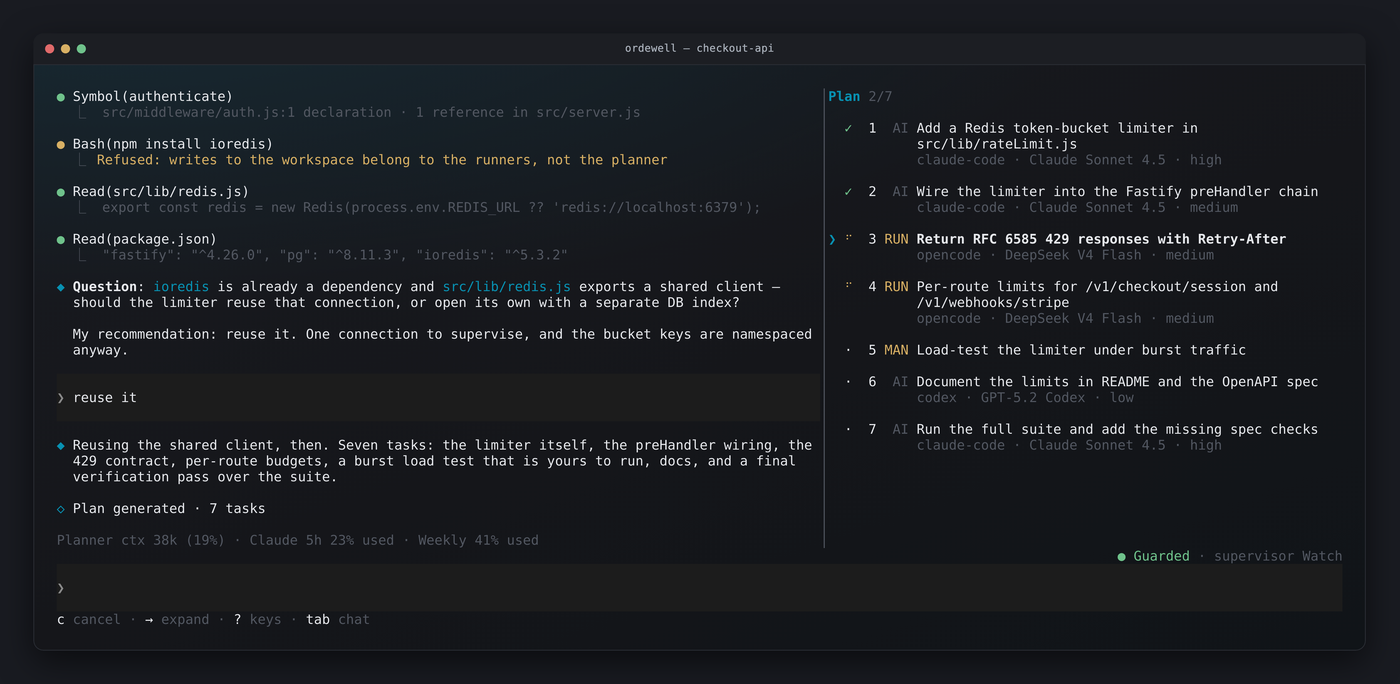
Ordewell is an open-source multi-agent task orchestrator for that job. You describe a goal; it reads the repo, asks about anything left vague, and returns an editable plan. Build tasks wait for approval by default. Each change can run on its own git worktree/branch; you read the diff before merge. It drives Claude Code, Codex, OpenCode, GitHub Copilot CLI, Qwen Code, Cline, Gemini CLI, and Cursor CLI—eight runners that can share one plan.
On Launchpadly, slug ordewell, category AI & Machine Learning, tagline Stop juggling agent tabs. Talk to one planner., listed 2026-11-04, Week 47 / 2026. Founder on the week board: Alessandro Ciano. Listing tech stack: TypeScript, Node.js, React, Electron, Hono, WebSockets. Site: https://ordewell.ai/. Repo: github.com/ordewell/ordewell (Apache 2.0).
Disclosure: Independent Launchpadly editorial from public pages and the public README/docs reviewed November 2026. We did not run a production multi-agent refactor, time parallel worktrees on a large monorepo, or verify every ACP agent version floor. Screenshots and demo clips (e.g. 0.10.x / 0.11.x captures on the homepage) can lag the install you get—confirm the live docs and changelog. The Launchpadly about blurb still names Claude Code, Codex, and OpenCode with “more coming soon”; the product/docs already list eight agents—prefer the site and README.
Key takeaways
- Job: one goal → editable plan → parallel agent tasks → human review/merge, not another chat tab and not a hosted “AI IDE” subscription.
- Default safety: build plans wait for approval; autorun and auto-merge are opt-in. “Done” means the agent’s completion report (or a script exit)—no second model rubber-stamping quality.
- Install is concrete: macOS/Linux one binary (
curl …/install.shor Homebrew); Windows/npm path needs Node ≥20.3 (TUI mouse/paste ≥22.17 + Git for Windows); VS Code extensionordewell.ordewell(Open VSX for Cursor/Windsurf/VSCodium). - Pre-1.0: README for 0.13.x warns minor releases can break things—read the changelog before upgrading. Telemetry is a daily version check with a random install ID (opt out via
ORDEWELL_NO_VERSION_CHECK/DO_NOT_TRACK).
What is Ordewell?
Ordewell is local planner + runner supervision for coding-agent CLIs you already installed and signed into. The planner explores without modifying the tree, writes tasks that name agent/model/effort/mode/dependencies, then executes under your run settings. Research and consented script tasks can start earlier under documented rules; code changes stay gated unless you turn automation on.
It is not a cloud seat, not a replacement for git discipline, and not a promise that mixing eight agents will always beat one strong session. Without git (or with isolation off), tasks share the folder—collision risk is real.
License: Apache 2.0; name/logos reserved per NOTICE. Contact/community: GitHub issues and discussions (README points to a first-run discussion thread).
Evaluation methodology
Reviewed November 2026 against:
- ordewell.ai, Docs, News, no-api-key
- GitHub README (describes 0.13.3 at research time)
- Launchpadly
/startup/ordewelland Week 47 / 2026 board
We did not install every runner, stress ACP version minimums, or audit SECURITY.md behaviors beyond published claims. Competitive notes are category positioning.
Product overview
The problem it actually attacks
Three failure modes: (1) tab juggling across agent CLIs, (2) unreviewed parallel edits landing on one branch, (3) opaque “done” when a second model guesses. Ordewell’s bet is a visible plan, per-task runner controls, worktree isolation when git allows, and completion reports you can see fail.
Surfaces
| Surface | How you start | Notes |
|---|---|---|
| Terminal UI | ordewell in a project |
Conversation + live plan; single-key plan controls |
| VS Code / Cursor / Windsurf / VSCodium | Extension ordewell.ordewell |
Bundled core; panel above the composer |
| CLI / headless | ordewell plan → run → handoff |
Pipeline-friendly; set AI_PROVIDER |
| Local API | Documented in product features | For wiring your own loops |
Who it is for (as published)
Developers and small teams already paying for (or logged into) at least one supported coding agent; people who want skills (repo-shared instructions; built-ins like grilling / to-spec / TDD adapted from Matt Pocock’s skills); operators scripting plans over SSH.
Key features
Eight runners, one plan
Supported out of the box (docs/README): claude-code, codex, opencode, copilot-cli, qwen-code, cline, gemini-cli, cursor-agent. Each can plan and execute; the planner assigns per task; you can move a paused task to another agent with unfinished work. Newer five use ACP with published version floors (e.g. Copilot CLI 1.0.105+, Qwen Code 0.26.6+, Cline 3.0.74+, Gemini CLI 0.66.0+; Cursor CLI tested around 2026.10.22 per docs). Missing binaries are greyed out with a reason—not offered then failed.
No second API key by default
Default planner is a coding-agent CLI you already have. Ordewell does not read or store that login (per no-api-key). Optional built-in runner path uses a provider API key when you want it. Agent planners start read-only (edit/shell withheld or sandboxed per runner).
Isolation, limits, skills
git ≥2.38 recommended for worktrees, delegated child plans, and Merge all. Usage limits pause tasks (Claude Code/Codex name reset windows); after restart, paused work waits for you. Repo skills attach team workflow to matching tasks. Check-and-fix loops, research tasks, and consented scripts sit beside code tasks.
What “done” means
A task completes when the agent reports through Ordewell’s tools, or a script’s exit status says so. No second-model quality judge. A task that never reports fails where you can see it.
Pricing and honesty
There is no SaaS seat price on the public site. Cost is:
- Ordewell itself: free under Apache 2.0
- Your coding-agent subscriptions / API usage (tokens and rate limits still apply)
- Your time reviewing plans and diffs
Pre-1.0 instability is the real “price”: breaking changes between minors are explicitly warned. Daily version check sends version + random install ID after a one-time notice—nothing else, per README; disable with env flags if you want silence.
How Ordewell compares
| Need | Lean Ordewell | Lean one agent chat | Lean hosted multi-agent cloud | Lean raw git worktrees by hand |
|---|---|---|---|---|
| Editable multi-agent plan | Core design | Weak | Often yes, paid | Manual |
| Use existing CLI logins | Default | N/A | Often new keys | N/A |
| Human approve before build | Default on | You must remember | Varies | Manual |
| Open source, local | Yes | Agent-dependent | Rarely | Yes |
| 1.0 stability contract | Not yet | Agent-dependent | Vendor SLA | N/A |
Who should use Ordewell
- Developers already on Claude Code / Codex / OpenCode (or the wider eight) who want parallel tasks without losing the plan.
- People who will edit prompts, models, and dependencies before spending a token on build work.
- Teams that want repo skills shared across runners.
- Operators scripting
plan/run/handoffin CI-ish loops on a machine they control. - Contributors comfortable living on pre-1.0 open source and filing GitHub issues.
Who should avoid it
- Buyers who need a hosted product, invoice, and support SLA—not a local binary.
- Developers with no coding-agent CLI installed and no willingness to add one (or a provider key for the built-in runner).
- Anyone who wants autorun + auto-merge as the only mode and will skip reading diffs—Ordewell can enable automation, but that is how you get merge surprises.
- Orgs that cannot accept pre-1.0 breaking changes or a daily version ping without procurement review.
- Users on constrained Windows setups who will not meet Node / Git for Windows requirements for the TUI path.
Editorial ratings
Launchpadly editorial judgment from public materials—not a timed monorepo lab. Scores match the labels in meta.
| Category | Score (/10) |
|---|---|
| One binary / VS Code panel | 7 |
| Apache 2.0; use your agent login | 9 |
| Eight mixable coding agents | 8 |
| Parallel worktrees; autorun optional | 8 |
| Plans, skills, CLI + extension | 8 |
Ease (7): Sharp once an agent is installed; Windows/Node and multi-runner setup are real friction. Value (9): No Ordewell fee; you already pay the agents. AI (8): Breadth of runners and planner transports; quality still equals the underlying agent. Automation (8): Parallelism + optional autorun with sane defaults. Depth (8): Plans, skills, isolation, headless—pre-1.0 roadmap items (daemon resume, standing consent) still open.
Pros and cons
Pros
- Clear approve-before-build default with visible per-task agent/model/effort
- Eight mixable runners with greyed-out honesty when a binary is missing
- Worktree isolation when git is new enough; diff-then-merge handoff
- No extra API key required if you already have a coding agent
- Apache 2.0 with serious docs, ADRs, and a public roadmap
- Completion via agent report / script exit, not a second-model “LGTM”
Cons
- Pre-1.0 breaking-change risk is explicit—upgrade carefully
- Launchpadly listing lags the eight-agent roster (still “Codex/OpenCode + more soon”)
- Without git isolation, parallel tasks can collide in one folder
- Depends on upstream agent quality, quotas, and ACP version floors
- Windows path is heavier (npm + Node 22.17+ for full TUI mouse/paste)
- We did not independently measure wall-clock wins vs a disciplined single-agent workflow
Real use cases
Rate-limit feature across agents. Plan in Claude Code; assign implementation, HTTP 429 behavior, and tests to different runners; approve; merge after reading three worktree diffs.
SSH on a remote Linux box. Install the binary, run ordewell, keep the plan on-screen while a long Codex task pauses at a usage limit and resumes later.
Team skill pack. Commit grilling/TDD-style skills in-repo so the planner attaches the same expectations regardless of which runner executes.
Headless refactor. ordewell plan --goal "…" → tweak a task model → ordewell run → handoff review before handoff merge.
Skip case. You only ever want one Cursor chat and never parallelize—installing an orchestrator adds ceremony without payoff.
Verdict
Ordewell is a credible local control plane for multi-agent coding: one editable plan, eight real CLI runners, worktree-minded isolation, and human approval before build work lands. Strongest if you already live in agent CLIs and want the plan in plain sight. Weakest as a hosted purchase or as a “set autorun and walk away” product while still pre-1.0.
Buy if (install if) you will keep at least one supported agent signed in, start with Guarded defaults, and read diffs before merge.
Skip if you need SaaS procurement, a finished 1.0 stability promise, or you will not maintain git worktree hygiene.
Start with the install one-liner or VS Code extension, skim docs, then optionally cross-check Launchpadly at /startup/ordewell.
FAQ
What is Ordewell best for?
Turning one coding goal into an editable, multi-agent plan, running tasks (often in parallel worktrees), and reviewing diffs before merge—using agents you already have.
How much does Ordewell cost?
The software is free/open source (Apache 2.0). You still pay for whatever coding-agent or API usage the runners consume.
Which agents does it support?
Eight: Claude Code, Codex, OpenCode, GitHub Copilot CLI, Qwen Code, Cline, Gemini CLI, Cursor CLI. Prefer docs/README over the shorter Launchpadly blurb.
Do I need an API key?
Not by default—a signed-in coding agent can plan and run. A provider key is for the optional built-in runner path.
Is it safe to let it edit freely?
Build tasks wait for approval by default. Autorun/auto-merge are settings you turn on. Planner starts read-only; see SECURITY.md and isolation docs before disabling guards.
What does pre-1.0 mean here?
Minor releases can include breaking changes. README (0.13.x at research) says read the changelog before upgrading.
Who built Ordewell?
Launchpadly’s Week 47 board lists founder Alessandro Ciano; LinkedIn company copy places the project in Milan. Confirm live founder details on their channels if you need them for a vendor packet.
Where should I start?
curl -fsSL https://ordewell.ai/install.sh | sh (or the VS Code extension) → open a git repo → type a small goal → approve the plan. Docs: ordewell.ai/docs. Directory context: Launchpadly /startup/ordewell.
Similar products on Launchpadly
 subba
 Spec27
 Word Studio
More AI & Machine Learning reviews

AI & Machine Learning
GPTinf Review: AI Detector + Humanizer Toolkit (Pricing, Limits & Caveats) — 2026
GPTinf packs an AI detector, humanizer, paraphraser, plagiarism checker, readability scorer, and gra…

AI & Machine Learning
Make Yourself AI (myai) Review: Operations Context for Manufacturing Teams (2026)
Make Yourself AI’s myai platform turns planner and operator judgment—plus ERP, spreadsheets, and fil…

AI & Machine Learning
Inkwell Review: AI Screenwriting IDE with Version Control (2026)
Inkwell is AI-native screenwriting software (Plot) with save points, draft lines, inline AI skills,…

AI & Machine Learning
xPomelo Review: Conversational AI Search for Adult Video Discovery (2026)
XPomelo (chat.xpomelo.com) is a free, anonymous conversational search layer over 60M+ third-party ad…