Make Yourself AI (myai) Review: Operations Context for Manufacturing Teams (2026)
Make Yourself AI’s myai platform turns planner and operator judgment—plus ERP, spreadsheets, and files—into apps, agents, and workflows for complex…

Reviewing Make Yourself AI · Published · 17 min read
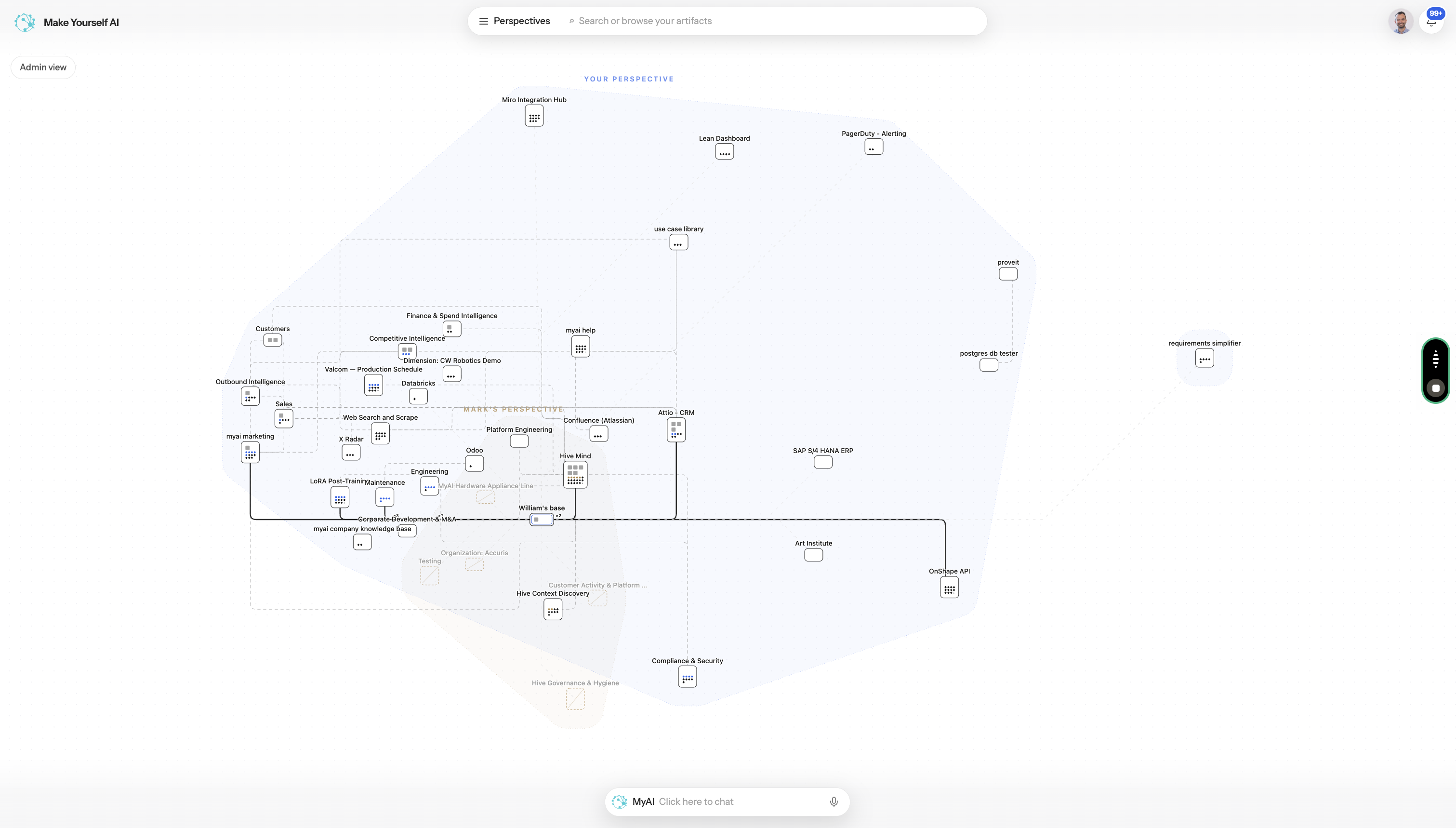
Opening
Manufacturing software already stores the transaction. What still walks out the door at shift change is the judgment: which release is actually shippable, why margin moved, which tooling signal is noise. Spreadsheets and hallway conversations absorb that work until volume grows and the same eight people become the bottleneck.
Make Yourself AI builds myai (pronounced maya) as an operations context platform—not another model-first chatbot bolted onto the plant. The public pitch is consistent across home, platform, and listing: start with the people who know the work, connect that judgment to systems already in place, then ship apps, agents, and workflows the rest of the organization can reuse. Tagline on Launchpadly: Build tools that reflect your expertise. On the product site: AI that reflects your people.
This review is based on makeyourself.ai (platform, solutions, pricing, proof of value, Apps 101, Agents 101, compare, Trust Center last updated 2026-07-07, About, and the published aerospace & defense customer story), plus the Launchpadly listing Make Yourself AI (slug make-yourself-ai, Featured / Paid / Verified, listed 2026-09-14, Week 38 / 2026). Product URLs are the source of truth; case-study numbers below are company-published with the caveats the story itself states. We did not run a paid production pilot.
Key takeaways
- myai is framed as shared operational context—ERP/MES/PLM/CRM/databases/spreadsheets/files plus the exceptions and reasoning those systems omit—turned into apps, agents, and workflows, not a single chat thread.
- Go-to-market is enterprise / forward-deployed: pricing is Custom with discovery → scoped proposal; there is no public self-serve seat price. Entry paths include a 30-minute discovery call, a structured proof of value, and a no-call operations assessment.
- The public solutions library spans run-the-day boards (lean daily management, machine monitoring, scheduling, warehouse/dock boards, SQDC, tool checkout), plan/improve, quote/grow, and close/learn finance surfaces—positioned as examples built around real rhythms, not generic templates.
- Published aerospace & defense case study metrics (attribute carefully): monthly operating-review prep 8 hours → 15 minutes (measured, first site); shop-order release 2 days → 2 hours (reported, second site); tooling demand triage 358 signals → 4 to review (validated system output). The story separately flags ~20 hours/week reporting as a first-site estimate, not measured, and says growth/EBITDA impact is not presented as measured results.
- Trust posture is unusually candid: pre-certification, aiming for SOC 2 Type I in roughly two to three quarters from the July 2026 Trust page; internal mapping to NIST SP 800-171 Rev 2; US-region Google Cloud + AWS; AI via Vertex AI (Gemini) and Bedrock (Claude) with a no training on customer data claim. Buyers who need a finished SOC 2 report before any pilot should treat that as a hard gate.
What is Make Yourself AI?
Make Yourself AI Inc. ships myai, an operations platform for manufacturers and other complex operations where important decisions cross departments, systems, and experienced people. The Launchpadly about copy and site both stress the same non-replacement thesis: do not force teams off the ERP, spreadsheets, documents, email, and workarounds they already use—begin with how work actually gets done and give expertise greater reach.
The platform’s claimed loop:
- Connect operational data from existing systems and files.
- Learn from people—goals, judgment, exceptions raw data cannot explain.
- Build fit-for-purpose apps, workflows, dashboards, and agents.
- Retain corrections, sources, and execution history so the next person or site does not start from zero.
- Combine flexible AI reasoning with deterministic calculations and business rules.
Legal / product identity on-site: Make Yourself AI Inc.; product nickname myai; pronunciation maya. About page founders: Mark Freedman (floor quality engineer → lean leadership → nearly six years leading product growth and partner/platform strategy at Tulip) and William VanBuskirk (GE Aerospace, PwC, Tulip; metals, defense, medical device, biopharma factories). The Launchpadly listing is attributed to founder account william (@william).
It is not a self-serve consumer AI seat, not an ERP replacement, and not (per their own compare page) the right default when the entire workflow and its data already live cleanly inside one ERP’s native AI.
Evaluation methodology
Reviewed September 2026 against public materials only:
- Home, Platform, Solutions (+ lean daily management / quoting solution pages), Pricing, Proof of value, Compare, Apps 101, Agents 101, About, Contact, Trust (2026-07-07), status.makeyourself.ai
- Aerospace & defense manufacturer case study
- Launchpadly
/startup/make-yourself-ai
We did not sign an NDA, ingest a customer data extract, or measure live plant KPIs ourselves. Competitive notes below follow category framing from Make Yourself AI’s compare page plus ordinary buyer alternatives—those are positioning aids, not independent lab rankings.
Product overview
Shared context as the product
The platform page centers one idea: a shared operational foundation—records, relationships, decisions, exceptions, and local rules—that feeds three entry points:
| Surface | Job (as published) |
|---|---|
| Artifacts / apps | Make the operation legible; apps, documents, decisions, and definitions stay connected |
| Chat / agents | Ask the operation directly; inspect evidence; move into the next action |
| Compounding | Reuse context across use cases and sites so the next site starts ahead |
Underneath, the site describes operating primitives: Connect (ERPs, APIs, files, cloud services, devices, machines), Run (SQL, Python, JavaScript, and functions on schedule or event), Reach (apps, chat, workstations, web, mobile, text), Govern (roles, permissions, ownership, approvals, trace)—plus adoption visibility across apps and teams.
Who operates what
Your planners, operators, engineers, and finance people remain authors: they teach what good looks like, correct assumptions, and shape tools. Make Yourself AI’s commercial motion puts a forward-deployed engineer alongside those people for the first scoped problem. That split matters for buyers used to buying seats online—you are buying a guided build against a real workflow, not a login and a prompt box.
Solutions as operating rhythms
Solutions are grouped by operating job, not by AI feature name:
- Run the day: lean daily management, machine monitoring, scheduling list, warehouse labor & productivity, wave & pick board, dock & receiving board, operator job terminal, shop-floor SQDC board, tool checkout
- Plan and improve: supplier scorecard, warehouse network scorecard, network center of gravity, slotting optimizer
- Quote and grow: quoting & estimating, pricing strategy (including a “quad view”), cross-sell intelligence
- Close and learn: financial operating review, material-cost intelligence, finance command center, job cost analysis
The site is explicit: these are examples of working tools around a meeting, decision, or rhythm—not a claim that every customer gets every board on day one.
Key features
Apps shaped by local rules (Apps 101)
Apps 101 is the clearest product thesis page. A generic prompt can spit out an SQDC template; a useful plant app, they argue, must encode live signals, local rules, ownership, next decision, source/trace, and what the board learns. The page contrasts a generic daily-management board with a sheet-metal standup fitted to machines, scrap, job age, and named quality holds.
The compounding claim is operational, not poetic: a first daily management app teaches sites, work centers, shifts, owners, metrics, and escalation; a later tool checkout reuses people/roles and adds calibration/return rules; a shortage escalation reuses jobs and escalation paths and adds parts/suppliers. Whether that reuse holds in your plant is exactly what a proof of value is for—but the design intent is clear: the fifth app should be cheaper than the first because context accumulates.
Agents as a harness, not a raw model (Agents 101)
Agents 101 walks the same purchase-order question through three layers: raw LLM (no system access), light tool-loop harness (many copilots stop here), and a “real harness” that carries a business model—POs, suppliers, parts, work orders, and relationships they call dimensions—then coordinates multi-step work with shared state. Their line: most marketed “agents” are layer 2; myai aims at layer 3, with shared operational context that persists across conversations, users, and apps.
Practical buyer translation: if your RFP only asks “which model,” you will miss the product. The scarce asset they sell is context construction + governance + reuse, with models as replaceable engines (Gemini via Vertex, Claude via Bedrock per Trust).
Proof of value as the sales process
Proof of value is four phases: Discovery (one hard workflow, systems, measure) → Working proof (NDA + small representative extract → focused app/agent/workflow) → Show-back (experts test and refine) → Proof of value (narrow production run with time/cost/margin/operating impact). Scope is framed on the physical value chain—engineer → plan → source → make → deliver. Output is described as a decision packet: expand, pause, or redirect—not a sandbox demo theater.
Home and POV also reference a PE-backed aerospace and defense supplier as the public proof narrative; the detailed write-up lives on the case-study URL above.
Published customer outcomes (with their own asterisks)
From the aerospace & defense case study:
| Claim | Number (as published) | Attribution on-page |
|---|---|---|
| Monthly operating review preparation | 8 hours → 15 minutes | Measured at the first site |
| Shop-order release cycle | 2 days → 2 hours | Reported by the second site |
| Tooling demand triage | 358 signals → 4 to review | Validated system output |
| Weekly reporting work shifted into apps/agents | ~20 hours / week | First site’s own estimate, not a measured result |
| Growth / EBITDA | — | Explicitly not measured results in the story |
Working pattern described: separate ERP status from the planner’s Good / Maybe / No call; keep overrides and reasons attached; reuse across planning, daily management, monthly operating review, and margin analysis; transfer via customer builders to a second site in a focused build week. Interfaces shown are labeled illustrative synthetic data—do not treat screenshots as your data.
Trust and security (what they disclose)
The Trust Center (last updated July 7, 2026) is worth reading before any security questionnaire:
- Customer data in United States regions on Google Cloud and AWS; they state they do not currently host outside the US and that customers/data subjects they serve are U.S.-based
- TLS 1.2+ in transit; encryption at rest by default on Google Cloud; customer-managed encryption keys (CMEK) for production workloads called out as roadmap (SOC 2 prep)
- Admin access via workload identity federation, least-privilege IAM, MFA for human admins
- AI: Vertex AI (Gemini) and Amazon Bedrock (Anthropic Claude); claim that providers do not train foundation models on their customer prompts/outputs under those service terms; AI processing for customers in the US
- Compliance: pre-certification; working toward SOC 2 Type I in the next two to three quarters (from that page’s date); internal program mapped to NIST SP 800-171 Rev 2
- Status page: status.makeyourself.ai
- Contacts:
[email protected],[email protected],[email protected]; vulnerability disclosure program (no monetary bounty stated)
Honest limitation with consequence: if your plant or PE board requires a completed SOC 2 report or CMEK today, the public Trust page says you are early—budget questionnaire time and a direct security conversation, or wait.
Pricing and value
What is published
Pricing does not show a seat ladder. The card is Enterprise — Custom, scoped to your operations, with forward-deployed guidance, operational context/workflows around your team, integrations scoped to the use case, a baseline and success measures, and a roadmap for later use cases/sites.
How they say they price:
- Conversation (what is broken; “no pitch deck”)
- Discovery (systems, workflows, people; first proof)
- Proposal (scope, timing, deliverables, pricing)
FAQ on that page: cost depends on the problem, the systems/processes it crosses, and the scope of the first proof—hence no self-serve price. They start where operational importance and measurable value meet (P&L or operating KPI). Forward-deployed means an engineer works alongside the people doing the work.
Value judgment (editorial)
Transparency of process is high; transparency of dollar outcomes before a call is low by design. That is normal for forward-deployed industrial software and hostile to indie founders hunting a $49/mo experiment. Value shows up if: (a) you already know the painful workflow, (b) you can free experts for discovery/show-back, and (c) a failed proof is allowed to kill the deal—as their POV copy itself argues.
Contact for non-pilot topics: [email protected]; primary commercial CTA remains book a discovery call.
How Make Yourself AI compares
Framed using their Compare categories plus ordinary buyer alternatives:
| Need | Lean myai | Lean ERP-native AI (e.g. Epicor Prism–class) | Lean general computer-using agents | Lean Retool / Power Apps–style internal apps | Lean prompt-to-app builders (Lovable / v0–class) |
|---|---|---|---|---|---|
| Work spanning ERP + Excel + documents + local judgment | Core pitch | Strong when everything lives in one ERP | Weak on shared plant context & reuse | Strong if a CoE builds for the business | Fast prototype; weak multi-site governance story |
| Operators shape tools directly | Explicit | Usually IT/vendor-led inside the ERP | Individual handoff of digital chores | Often analyst/CoE mediated | Builder may not be the floor expert |
| Governance, trace, reusable context across sites | Emphasized | ERP-bound | Thin | Governance varies | Usually thin |
| Self-serve trial this afternoon | No public path | Depends on ERP license | Often yes | Often yes | Usually yes |
Use myai when the scarce asset is shared operational context across people and systems, with a team willing to lead the first use case. Skip category comparisons that pretend every “AI agent” product is solving plant operating reviews the same way.
Who should use Make Yourself AI
- Multi-site or high-complexity manufacturers (aerospace/defense-style ops are the public reference, not the exclusive buyer) where volume growth is drowning experienced planners and finance in reconstruction work.
- Ops, continuous-improvement, and plant IT leaders who can name one workflow, one measure, and the people closest to the work for a 30-minute discovery and a later show-back.
- Teams that want apps and agents on the same context—daily boards that feed scheduling and operating reviews—rather than another disconnected dashboard project.
- Buyers comfortable with US data residency as described on Trust and with engaging
security@/ a DPA conversation early. - Organizations that will treat site experts as builders, not only ticket requesters—matching the case study’s “customer builders” transfer model.
Who should wait
- Anyone who needs a credit-card self-serve product with published per-seat prices this week.
- Teams whose procurement gate is a finished SOC 2 Type I/II report or production CMEK before any data extract—Trust says those are in progress / roadmap.
- Orgs whose painful workflow lives entirely inside one ERP with acceptable native AI—their own compare page says choose ERP-native AI then.
- Buyers who only want a general computer-using assistant for personal digital chores across websites—wrong wedge.
- Non-US data residency requirements that conflict with the Trust page’s current US-hosting statement—confirm with legal before assuming fit.
- Groups that cannot free planners/operators for discovery and show-back; without that time, forward-deployed work stalls and you will blame the model.
Editorial ratings
Launchpadly editorial judgment from public materials—not a lab reliability scorecard on your plant.
| Category | Score (/10) |
|---|---|
| Discovery & forward-deployed start | 6 |
| Custom enterprise pricing clarity | 7 |
| Context harness, apps & agents | 8 |
| Workflows, schedules & reuse | 8 |
| Solutions library & platform | 8 |
Ease (6): Narrative and education pages (Apps 101, Agents 101, POV) are strong; getting hands on the product still means a sales/discovery motion, NDA, and data extract—not an afternoon sandbox signup. Value (7): Process and proof framing are clear; dollars stay opaque until proposal, which is honest for the category but hard to budget from the website alone. AI capability (8): The harness-and-dimensions story is sharper than most agent marketing; model stack is disclosed. Automation (8): Connect/run/reach/govern plus scheduled functions and multi-app compounding is a real ops automation thesis if context sticks. Depth (8): Broad solutions map; depth for any one customer still depends on what the engagement actually builds.
Pros and cons
Pros
- Clear differentiation: person-and-operation first, model second—backed by concrete Apps/Agents explainer pages
- Commercial motion matches the product: scoped proof of value with real users and a kill/expand decision, not demo theater
- Solutions library maps to real plant rhythms (huddles, docks, quoting, operating review) instead of abstract “AI use cases”
- Case study publishes mixed evidence quality (measured vs reported vs estimate) instead of only vanity metrics
- Trust page is specific about pre–SOC 2, US hosting, AI sub-processors, and contacts—usable for diligence
- Founder backgrounds (floor/lean/Tulip; GE Aerospace/PwC/Tulip) match the industrial buyer, not generic SaaS growth theater
Cons
- No public self-serve pricing or trial—evaluation cost is calendar time with the vendor
- SOC 2 not complete; CMEK called roadmap—enterprise security gates may block or delay pilots
- Public proof is concentrated in one aerospace & defense narrative; your vertical still needs its own measure
- Breadth of the solutions catalog can oversell day-one scope; you still buy one workflow first
- Requires scarce expert time; without planner/operator ownership, context never enters the system
Real use cases
Monthly operating review that still takes a day to assemble. Use the case-study pattern: join product-line performance, GL-based EBITDA, and cash conversion on one prepared surface so leaders decide instead of reconciling decks. Measure prep hours before and after; do not import their 8→15 claim as your baseline.
Planner ship commitment vs ERP “ready” status. Charter Good/Maybe/No separately from system status; surface only exceptions; keep overrides and reasons for the next month. Success looks like fewer one-at-a-time ERP lookups and a shared commit, not a fully autonomous scheduler.
Lean daily management that dies after the huddle. Start with a board that carries owners, due dates, and escalation into the next systems—scheduling, quality, maintenance—so actions do not vanish when the meeting ends (lean daily management).
Estimating / quoting that ignores floor reality. Connect routed vs actual hours and job-level margin into the next quote (solutions + case-study margin analysis). Keep humans on price authority; use the tool to stop rebuilding the variance story from scratch.
Second-site rollout after a first-site win. Budget a transfer week with builders from site one, mapped fields, and local adaptation—exactly the compounding story they sell. If you cannot staff that transfer, do not buy “multi-site AI” as a slogan.
Verdict
Make Yourself AI’s myai is a serious bet that manufacturing’s AI gap is missing operational context and reusable judgment, not missing another chatbot. The product story (apps + agents on one foundation), the sales story (forward-deployed proof of value), and the public case study (multi-site aerospace & defense, with honest metric caveats) line up more tightly than most agent marketing we see on Launchpadly.
Buy if (book discovery) you have a painful cross-system workflow, can put experts in the room, accept custom enterprise pricing, and will measure one operating KPI before expanding sites.
Skip if you need self-serve SaaS this week, a completed SOC 2 attestation before any extract, or an ERP-only problem that native AI already covers.
Start at makeyourself.ai: take the operations assessment if you are not call-ready, or book the 30-minute discovery with one workflow and one measure written down. Read Trust before you send data. Treat published case-study numbers as their evidence packet—rebuild the baseline on your floor.
FAQ
What is Make Yourself AI best for?
Turning operator and planner judgment plus existing ERP/spreadsheet/file context into apps, agents, and workflows for complex manufacturing and industrial operations—especially where decisions cross systems and sites.
How much does myai cost?
Public pricing is Enterprise / Custom only. Scope, timing, deliverables, and price come after conversation and discovery. There is no published self-serve monthly seat fee on makeyourself.ai/pricing during this review.
Is there a free trial?
Not as a self-serve product trial. Paths called out on-site: operations assessment (no call), 30-minute discovery call, then a paid/scoped proof of value with NDA and a small data extract when there is a fit.
Who founded Make Yourself AI?
About page names Mark Freedman and William VanBuskirk. The Launchpadly listing is under founder account william. Legal entity referenced on the site footer: Make Yourself AI Inc.
Does Make Yourself AI have SOC 2?
As of the Trust Center update 2026-07-07, they describe themselves as pre-certification, working toward SOC 2 Type I within roughly two to three quarters, with an internal program mapped to NIST SP 800-171 Rev 2. Confirm current status with [email protected].
What results has the public case study claimed?
For a multi-site aerospace & defense manufacturer: 8h → 15m monthly operating-review prep (measured, first site); 2 days → 2 hours shop-order release (reported, second site); 358 → 4 tooling signals to review (validated output). ~20 hours/week reporting is labeled an estimate, not measured; growth/EBITDA are not claimed as measured results on that page.
Similar products on Launchpadly
 subba
subba Spec27
 Word Studio
More AI & Machine Learning reviews

AI & Machine Learning
Inkwell Review: AI Screenwriting IDE with Version Control (2026)
Inkwell is AI-native screenwriting software (Plot) with save points, draft lines, inline AI skills,…

AI & Machine Learning
xPomelo Review: Conversational AI Search for Adult Video Discovery (2026)
XPomelo (chat.xpomelo.com) is a free, anonymous conversational search layer over 60M+ third-party ad…

AI & Machine Learning
ContentPod Review: Voice-First AI Content Engine for Creators (2026)
ContentPod turns one guided voice interview into linked drafts for blog, social, email, FAQ, and vid…
AI & Machine Learning
xEVE.ai Review: Video-First AI Companion Platform (2026)
XEVE.ai (Xeve) is an 18+ adult AI companion platform with live video chat, image/video generation, a…