Zinn Hub Review: A Borderless Freelance Market With Fine Print Worth Reading (2026)
Zinn Hub combines fixed-price services, custom project proposals, freelancer profiles, machine translation across 46 site languages, local-currency display,…

Reviewing Zinn Hub · Published · 17 min read
Opening
Freelance marketplaces usually make one of two promises: a bigger pool of talent, or a cheaper transaction. Zinn Hub makes a more interesting bet. It treats language, payment rails, and seller economics as parts of the marketplace product, not checkout details to bolt on later.
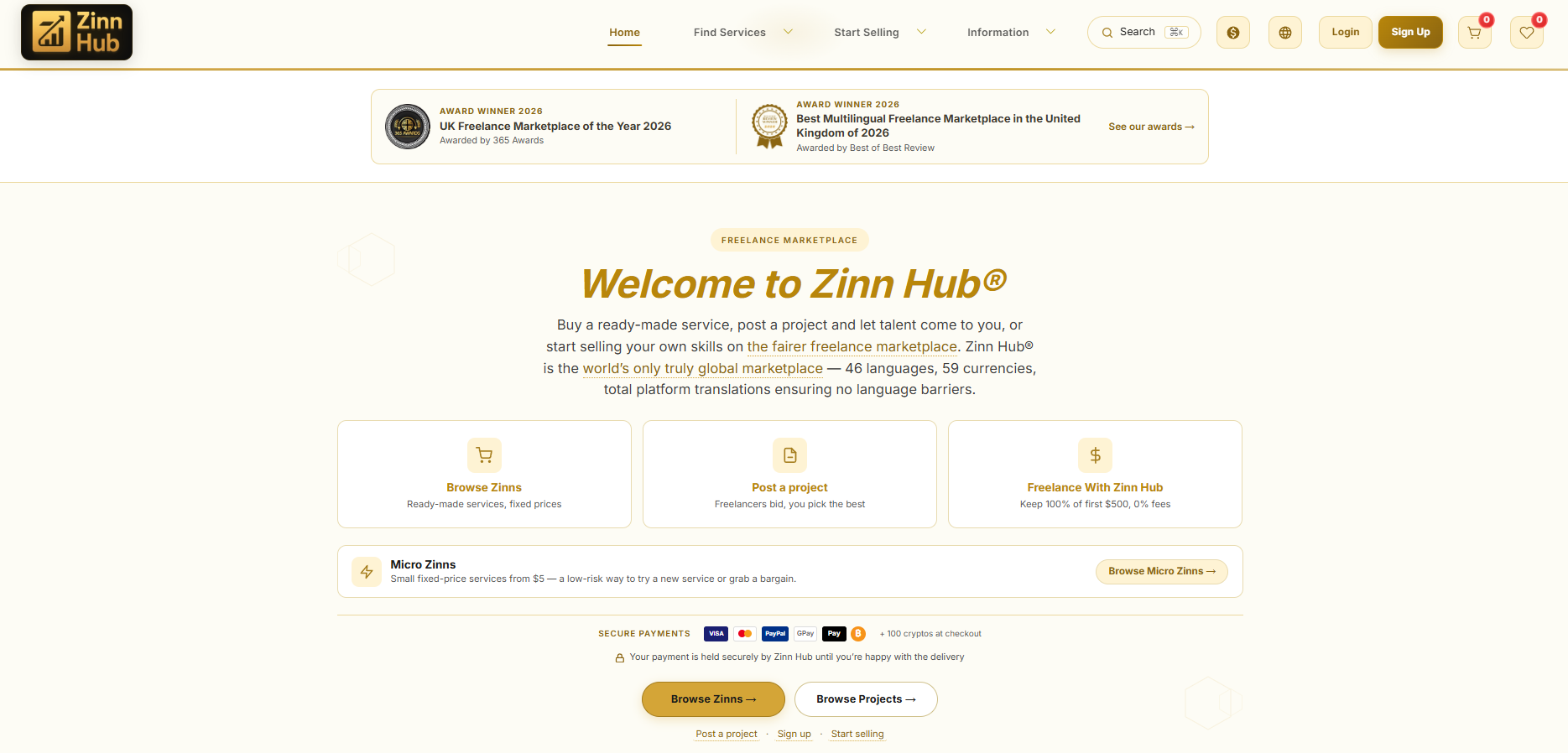
A buyer can purchase a Zinn, post a project, or browse freelancer profiles. A seller can package fixed-price, custom, subscription, hourly, and $5–$20 “Micro” services. Zinn Hub claims 46 site languages, 59 display currencies, translated messages and calls, mainstream checkout, crypto, and no buyer platform fee.
That combination is the product truth. Zinn Hub is not merely “another Fiverr alternative with lower fees.” Its best argument is that a good freelancer should not become invisible because the buyer searches in another language or prefers another payment rail.
Borderless transactions create more places where wording matters. Direct and platform payments hold funds differently. Refunds go to a closed-loop wallet, deliveries auto-accept after five days, and original-language messages control disputes. Sweeping verification copy also meets more conditional Terms language.
On Launchpadly, Zinn Hub is listed under Other, dated 2026-10-02, with the tagline “The Fairer Freelance Marketplace for Buyers & Freelancers.”
Disclosure: Independent Launchpadly editorial from public pages reviewed in October 2026. We did not order, submit identity documents, run a translated call, or resolve a dispute. Confirm the payment badge, Pricing, Refund Policy, and Terms before paying.
Key takeaways
- Zinn Hub combines three hiring paths: buy a packaged Zinn, post a custom project and compare proposals, or approach a freelancer through the public directory. Micro Zinns add a $5–$20 trial purchase.
- The strongest differentiation is cross-language commerce: the vendor says the marketplace runs in 46 languages, displays 59 currencies, translates listings and messages, localises text in listing images, and supports real-time call translation.
- Buyer economics are simple on the surface: 0% Zinn Hub platform fees. Seller economics need a calculator: the Free plan starts at 0% commission for the first $500, then moves through 20%, 15%, 13%, 10%, and 8% cumulative-sales tiers; Pro is $25/month at 8%, Agency $50/month at 7%.
- Payment protection depends on the payment mode. Platform Payments are held by Zinn Hub before completion; Direct Payments go to the seller’s connected Stripe or PayPal at checkout. The site says both receive protection, but the money is not held in the same place.
- Every approved refund is issued in USD to the closed-loop Zinn Wallet, cannot be withdrawn externally, and must be spent on Zinn Hub. Orders become final when accepted or after the five-day review window expires.
What is Zinn Hub?
Zinn Hub is a digital-services marketplace operated by Zinn Digital LTD, an England and Wales company (number 16385785). Its public About page presents a deliberately small operation: CEO and co-founder Neil Lock leads product, engineering, SEO, and a free Concierge service; co-founder Natalie Lock handles content, social, community, branding, and operations.
The vocabulary is proprietary but the models are familiar:
- A Zinn is a ready-made service listing with defined packages, requirements, delivery terms, and optional add-ons.
- A Micro Zinn is a fixed $5, $10, $15, or $20 service intended as a small task or trial engagement.
- A Project is a buyer brief with a budget, deadline, category, and proposals from freelancers.
- A Freelancer Profile exposes skills, portfolio, indicative hourly and project rates, reviews, availability, and listings.
- A Custom Offer handles scoped work that does not fit a public listing.
The marketplace spans development, SEO, advertising, design, video, writing, translation, data, AI, blockchain, cybersecurity, finance, assistance, and consulting. The Projects page showed open briefs and completed jobs rather than a demonstration shell. That establishes activity, not marketplace-wide liquidity.
Zinn Hub’s public pages make several scale claims—such as “hundreds of Zinners” and “join thousands of satisfied clients”—without publishing an independently auditable marketplace dashboard. We therefore do not treat those phrases as verified operating metrics. The live directory and completed-project feed are more useful evidence than an unqualified counter.
Evaluation methodology
We reviewed the homepage, Launchpadly listing, Pricing, Projects, Freelancer Directory, AI Zinn Creator, Migration, Refund Policy, Terms, Privacy Policy, and About page. Vendor statements are attributed where we could not test them. We did not independently verify identities, skill checks, imported reviews, payout speed, processor licensing, security controls, or translation quality.
The product thesis: reduce transaction distance
The usual marketplace assumes both parties understand the listing, negotiate in one language, use the same payment rails, and trust one dispute process. Zinn Hub attacks all four distances: broad search and Zinn Finder for discovery; packages, briefs, hourly work, subscriptions, and offers for scoping; local-currency display plus mainstream and crypto payments; and automated translation of listings, reviews, profiles, projects, proposals, and messages. The Privacy Policy names Google Cloud Vertex AI/Gemini for content translation and Google Cloud speech and translation services for calls.
This is a coherent thesis, not a bag of unrelated features. It also creates the review’s central caution: a translated, multi-rail transaction needs stricter pre-purchase discipline, not less.
How buying works
Buyers can browse and purchase a packaged Zinn, use a $5–$20 Micro as a paid audition, post a free brief for matched proposals, or invite someone from the directory. Profiles expose portfolio, availability, reviews, badges, and indicative rates; the accepted proposal, Zinn, or offer sets the binding price. Sellers do not buy per-bid credits: published limits are 25 proposals/month on Free, 100 on Pro, and unlimited on Agency.
The sensible path is profile → portfolio → transaction reviews → message → narrow paid scope. A badge should inform that process, not replace it.
Delivery and acceptance
After delivery, the buyer has five calendar days to review, request available revisions, raise a dispute, or accept. If the window expires, the order auto-accepts and becomes final through Zinn Hub. This deadline is operationally significant. Teams with slow legal, brand, or engineering approval should assign an owner before ordering and keep the delivery date on a shared calendar.
How selling works
Seller setup covers store and payments, listings, profiles, projects, imports, and promotion copy. The AI Zinn Creator drafts packages, add-ons, FAQs, requirements, deliverables, and Micro Zinns from seller facts. The seller controls prices, delivery days, and revisions; Zinn Hub says AI cannot change those numbers or publish without approval. Writing is free. Optional images have initial allowances, then use credits advertised from $0.50 each; own-image uploads are free.
Import My Services can rebuild one pasted listing or propose up to three Zinns from a profile, carry over up to ten reviews per Zinn, and generate images. The page advertises 10 free lifetime imports. Reviews are checked against a source URL and labelled imported; competing-platform watermarks are rejected.
This attacks the real switching cost: rebuilding packages, assets, and reputation context. Imported reviews are not Zinn Hub transaction reviews, so buyers should read their provenance.
Pricing and value
Buyers
Zinn Hub charges buyers 0% platform fees. Posting projects, receiving proposals, and inviting freelancers are free. Service prices are set by sellers and treated as tax-inclusive under the Terms.
“What you see is what you pay” is a strong purchasing rule, provided the buyer also understands local-currency display. Terms say converted displays are indicative; underlying listing prices, wallet accounting, and refund credits operate in USD.
Sellers
Published October 2026 pricing:
| Plan / tier | Cost | Zinn Hub service fee | Main limits |
|---|---|---|---|
| Free: first $500 cumulative sales | $0/month | 0% | 20 Zinns; 25 proposals/month; 100 MB |
| Free: $501–$2,500 | $0/month | 20% | Same Free limits |
| Free: $2,501–$10,000 | $0/month | 15% | Same Free limits |
| Free: $10,001–$15,000 | $0/month | 13% | Same Free limits |
| Free: $15,001–$20,000 | $0/month | 10% | Same Free limits |
| Free: above $20,000 | $0/month | 8% | Same Free limits |
| Pro | $25/month | Flat 8% | 50 Zinns; 100 proposals/month; 500 MB |
| Agency | $50/month | Flat 7% | 200 Zinns; unlimited proposals/storage/files |
Two details prevent bad spreadsheet math.
First, the order that crosses the first-$500 threshold is charged at the applicable fee on the whole order, not only the portion over $500. A seller at $450 whose next completed order is $100 does not get $50 free and pay commission on the remaining $50; the full $100 order is commission-bearing.
Second, “no payout fees charged by Zinn Hub” does not mean every payout is costless. For Platform Payments, the seller receives the sale minus Zinn Hub commission, the payment processor’s fee, and any transfer cost. VAT may apply to Zinn Hub’s fee. Sellers are merchants of record and responsible for their own VAT, sales tax, income tax, and invoices.
Value is strongest at entry and sustained volume. Immediately after $500, Free jumps to 20%, while Pro’s 8% plus $25 can become cheaper quickly. Compare expected gross sales, not plan labels.
Payments, payouts, and the word “escrow”
Public buyer pages repeatedly use “escrow payment protection.” The Terms are more precise: for Platform Payments, Zinn Hub acts as a pass-through custodian, holds funds to facilitate the transaction, and explicitly says it is not an escrow service, regulated payment institution, or fiduciary.
That wording difference does not prove the protection is ineffective. It does mean buyers should understand the actual mechanism rather than rely on the marketing noun.
There are two modes:
- Platform Payment: Zinn Hub collects and holds funds before completion. Crypto orders always use this mode. Seller earnings are paid through the configured method, generally on the published Friday cycle and subject to rules, holds, minimums, and deductions.
- Direct Payment: Funds go to the seller’s connected Stripe or PayPal at checkout. Zinn Hub says buyer protection and mediation still apply, but it does not physically retain those purchase funds. The Pricing page says direct-payment listings are labelled separately.
“Instant payout” primarily means direct receipt through the seller’s connected Stripe or PayPal—not every sale on every rail.
Refunds and disputes: the limitation most buyers must know
Every approved refund is credited in USD to the Zinn Wallet, never the original payment method. Credit does not expire but cannot be withdrawn externally.
This is materially different from “your money back” in ordinary consumer language. It is platform credit. A $1,000 project refund leaves the buyer with $1,000 to spend on Zinn Hub, not $1,000 restored to a corporate card or bank account.
Before completion, cancellation negotiation can run for three 72-hour rounds; silence can grant the proposed percentage. Disputes give the other party 48 hours to respond before review. Zinn Hub considers the listing, on-platform messages, delivery, and evidence; outside communication may not count.
Refunds may be considered for non-delivery, complete unresponsiveness, or fundamental mismatch—not change of mind, subjective taste, out-of-scope requests, or completed orders.
The practical rule is simple: keep the brief, scope change, revision request, and acceptance decision in Zinn Hub messages.
Translation is the moat—and a contractual risk
Zinn Hub says it translates listings, profiles, reviews, projects, proposals, offers, messages, and text in listing images, with “show original” plus translated call captions or voice.
The Privacy Policy says translated content goes to Google Cloud without model training. Call audio is processed transiently and normally not retained. Listing quality analysis uses Anthropic’s Claude without identity data, payment details, or private messages in that payload, according to Zinn Hub.
The hard limit sits in Terms section 24A: machine translation is not authoritative. For user content and messages, the original language version controls. For Zinn Hub’s policies, English controls. The platform disclaims translation accuracy and tells users to verify material communication.
For translated work, put dimensions, formats, deadlines, revisions, licensing, and exclusions in a numbered message and ask the other party to confirm. Do not make a translated call the only record of a material agreement.
Verification, trust, and security claims
The homepage says “Every Freelancer ID Verified & Skill Checked” and “No exceptions.” The migration and AI Creator pages repeat that sellers are ID and skill verified before selling.
The live directory is less uniform at a glance. Some profiles visibly carry a Verified badge; several newly listed profiles in the same fetched page do not show it in their card text. That could reflect publication state, badge display rules, or a lag, but the public page does not explain the discrepancy. The Terms also say Zinn Hub reserves the right to request identity verification at any time, including before a first payout, rather than plainly documenting universal pre-listing KYC in the legal eligibility section.
That does not prove the promise false. Zinn Hub should publish a badge glossary explaining what is checked, when, and why some cards lack the badge.
The Privacy Policy names HTTPS, encryption at rest, Cloudflare protections, access controls, monitoring, and assessments. Payments are delegated to Stripe, PayPal, and NOWPayments. These are vendor statements, not a published penetration test. The policy also discloses analytics, remarketing, fingerprinting, international processing, and seven-year-plus transaction retention.
Competitive context
Zinn Hub sits between gig catalogues and proposal marketplaces: custom briefs, profiles, hourly work, subscriptions, free proposals, packaged services, and paid trials. Translation, crypto, and direct seller payments sharpen the difference. The fee claim needs segmentation: 0% for the introductory band, 20% immediately after it on Free, eventually 8%, or immediate 8%/7% on paid plans. “Fairer” depends on revenue.
Incumbents retain network depth. Search your category, inspect briefs and transaction reviews, and message likely counterparts before migrating. Features cannot manufacture demand.
Who should use Zinn Hub
- Buyers hiring digital services across language boundaries who will document critical scope in writing
- Founders who want a small paid trial through a Micro Zinn before a larger engagement
- Buyers who like both catalogue shopping and competitive custom proposals in one account
- New freelancers willing to test demand with no monthly plan and a first-$500 commission offer
- Established sellers who can use Pro or Agency economics, imported listings, and translated discovery
- Sellers serving buyers who prefer cards, PayPal, digital wallets, or supported crypto
Who should avoid it
- Buyers who require refunds to return to the original card or bank account
- Procurement teams that need a regulated escrow relationship, published enterprise SLA, SSO, or audit-log commitments
- Anyone likely to miss a five-day delivery review window
- Sellers assuming “0% starting fees” means 0% forever—the Free plan can charge 20% after the introductory threshold
- Regulated or high-stakes projects where machine translation cannot safely mediate scope
- Specialists whose category shows too little current buyer demand to justify migration
Risks and limitations
- Closed-loop refunds: Credits stay inside Zinn Hub.
- Five-day finality: Auto-acceptance closes the platform dispute route.
- Two payment mechanics: Direct receipt and held funds create different recovery mechanics.
- Translation authority: Original messages govern disputes.
- Verification ambiguity: Universal copy is hard to reconcile with inconsistent visible badges.
- Fee cliff: The threshold-crossing order is charged in full; Free then starts at 20%.
- Liquidity: Category demand varies; broad scale phrases are not independently substantiated.
- Small-team concentration: Founder access and operational capacity share the same dependency.
- Seller duties: Sellers carry merchant-of-record, tax, and invoicing obligations.
Editorial ratings
These are Launchpadly editorial judgments from public material, not community-star averages.
| Category | Score (/10) |
|---|---|
| Browse, brief, buy & deliver | 8 |
| 0% buyer fee; tiered seller fees | 8 |
| Translation, matching & listing tools | 8 |
| Creation, payouts & project matching | 8 |
| Services, projects, profiles & payments | 8 |
Ease (8): Three purchase paths and guided setup reduce friction; payment rules demand reading. Value (8): Buyer pricing and entry seller terms are strong; the post-$500 tier holds it back. AI (8): Translation, matching, creation, migration, and promotion address real jobs, with accuracy limits. Automation (8): Matching, drafts, payouts, translation, and imports remove repetition. Depth (8): Broad transaction coverage; enterprise controls and independent assurance remain thin.
Pros and cons
Pros
- Fixed-price services, custom projects, profiles, and custom offers in one marketplace
- 0% Zinn Hub buyer platform fee
- First $500 in qualifying seller sales at 0% commission, subject to threshold rules
- Full-market translation is more useful than menu-only localisation
- Micro Zinns create a paid trial path instead of unpaid spec work
- Free proposals with plan-based monthly limits rather than per-bid credits
- AI listing and migration tools preserve seller control over facts and prices
- Card, PayPal, digital-wallet, platform-wallet, and crypto options
- Public legal pages explain payment modes, auto-acceptance, and refund destination in unusual detail
Cons
- Refunds never return to the original payment method and cannot leave Zinn Wallet
- Free seller commission rises to 20% after the introductory band before falling with volume
- “Escrow” marketing is qualified by Terms that say Zinn Hub is not an escrow service
- Original-language messages control disputes even when users relied on translation
- Visible verification badges do not make the universal verification claim easy to audit
- Five days can be short for complex delivery review
- Marketplace depth varies by category, and public scale claims lack an auditable dashboard
Real use cases
Multilingual build. A French-speaking founder finds an English-speaking developer, then confirms pages, breakpoints, files, events, revisions, and deadline in numbered messages.
Paid audition. A brand buys one $15 social asset, evaluates delivery, then uses a custom offer for a batch—paid evidence instead of free spec work.
Second sales channel. A freelancer imports two listings, checks imported-review labels, publishes a profile, and applies only to matched projects. They model when Pro beats Free.
Crypto purchase. A buyer pays in crypto knowing it becomes a Platform Payment and any approved refund becomes USD wallet credit, not returned crypto.
Verdict
Zinn Hub’s defensible idea is not “freelancing, but cheaper.” It is freelancing with less transaction distance: less distance between packaged and custom work, between one language and another, between card and crypto buyers, and between a seller’s old storefront and a new one.
The breadth is credible: practical AI tools, paid trials, clean buyer pricing, and seller terms for initial testing and eventual volume. Yet the fine print determines the purchase. Buyers accept closed-loop refunds and five-day review; sellers model fees and merchant duties; both sides keep evidence on-platform.
Buy or join if cross-language discovery, flexible service formats, and broad payment support solve a real constraint—and you are comfortable with the wallet and acceptance rules.
Skip if refundable-to-card procurement, regulated escrow, enterprise assurance, or certified translation is mandatory. Sellers should also wait when their category has no visible buyer demand.
The right first move is small: inspect the relevant category, read a seller’s policies, message before purchase, and use a Micro Zinn or tightly scoped first project. Zinn Hub has earned a serious trial. It has not earned permission to skip diligence.
FAQ
What is Zinn Hub best for?
Cross-language digital-service work where multiple payment methods and both packages and proposals matter, especially small first engagements.
Does Zinn Hub charge buyers a fee?
Zinn Hub publishes a 0% buyer platform-fee policy. Buyers pay the listed service or accepted proposal price. Currency conversions shown on the site are indicative, so confirm the checkout currency and amount.
Is selling free?
Free has no monthly subscription: 0% commission on the qualifying first $500, then 20% down to 8% by cumulative sales. The threshold-crossing order is charged in full.
How much are Pro and Agency?
Pro: $25/month, 8%, 50 Zinns, 100 proposals. Agency: $50/month, 7%, 200 Zinns, unlimited proposals/storage/files. Confirm live pricing.
Are payments held in escrow?
Marketing says “escrow”; Terms call Zinn Hub a pass-through custodian and not an escrow service, regulated payment institution, or fiduciary. Direct Payments reach seller Stripe or PayPal at checkout.
Where does a refund go?
Every approved refund goes in USD to Zinn Wallet, never the original rail. Credit cannot be withdrawn but does not expire.
How long do buyers have to review delivery?
Five calendar days after delivery. A buyer should accept, request available revisions, or raise a dispute during that window. If it expires, the order auto-accepts and becomes final through Zinn Hub.
Does Zinn Hub translate messages?
The vendor claims 46 site languages, translated marketplace content and messages, “show original,” and translated calls. Original-language messages govern disputes.
Are all freelancers verified?
Marketing says every seller is ID and skill checked. Some directory cards showed Verified and some did not; Terms make identity requests conditional. Ask what each badge proves.
Can sellers import listings and reviews?
Yes: one pasted listing or up to three Zinns from a profile, ten free lifetime imports, and up to ten source-checked imported reviews per Zinn. Imported and native transaction reviews differ.
 CMDragon Tools
 LinkNest - AI Link Submission Tool for SEO Backlinks
 Midway