Skycloak Review: Managed Keycloak with Flat Pricing & Unlimited Users (2026)
Skycloak runs real upstream Keycloak with infrastructure-based pricing, unlimited users, and a 99.99% SLA. Our review covers plans, compliance, honest…

Reviewing Skycloak · Published · 14 min read
Opening
Your product finally has traction—50,000 monthly active users, enterprise prospects asking for SAML, and a finance team that just saw Auth0's renewal quote. The number that stuck wasn't the feature gap. It was the per-MAU line item climbing every quarter while your authentication code barely changed.
That bill is why teams adopt Keycloak, the open-source identity platform Red Hat stewards inside the CNCF. Keycloak does SSO, MFA, SAML, OIDC, social login, and fine-grained roles without a proprietary tax. The catch is operations: upgrades, CVE patches, HA clustering, backups, and the 2 a.m. pager when login breaks checkout.
Skycloak sells itself as the middle path—managed Keycloak as a service with flat, infrastructure-based pricing, unlimited users, and a contractual 99.99% uptime SLA. You get real upstream Keycloak (not a fork), full admin access, multi-region residency, and the freedom to export and self-host later. The pitch is simple: ship features, not auth infrastructure.
This Skycloak review explains how the product works, what each plan includes, where flat pricing actually saves money, who should self-host instead, and how it stacks up against Auth0, Okta, Phase Two, and DIY Keycloak.
Key takeaways
- Skycloak runs real upstream Keycloak—full admin console, realm export, no proprietary lock-in.
- Unlimited users on every plan; pricing scales by cluster size and features, not monthly active users or SSO connections.
- Plans start at $29/mo (Developer), $149/mo (Launch), and $599/mo (Business); Enterprise is custom-quoted.
- 99.99% SLA, SOC 2 Type II, ISO 27001, and GDPR compliance with residency in US, EU, Canada, Australia, and more.
- Best for teams already committed to Keycloak (or fleeing MAU-based IDaaS) who want production ops handled; weaker fit if you need the simplest possible greenfield auth with zero Keycloak learning curve.
What is Skycloak?
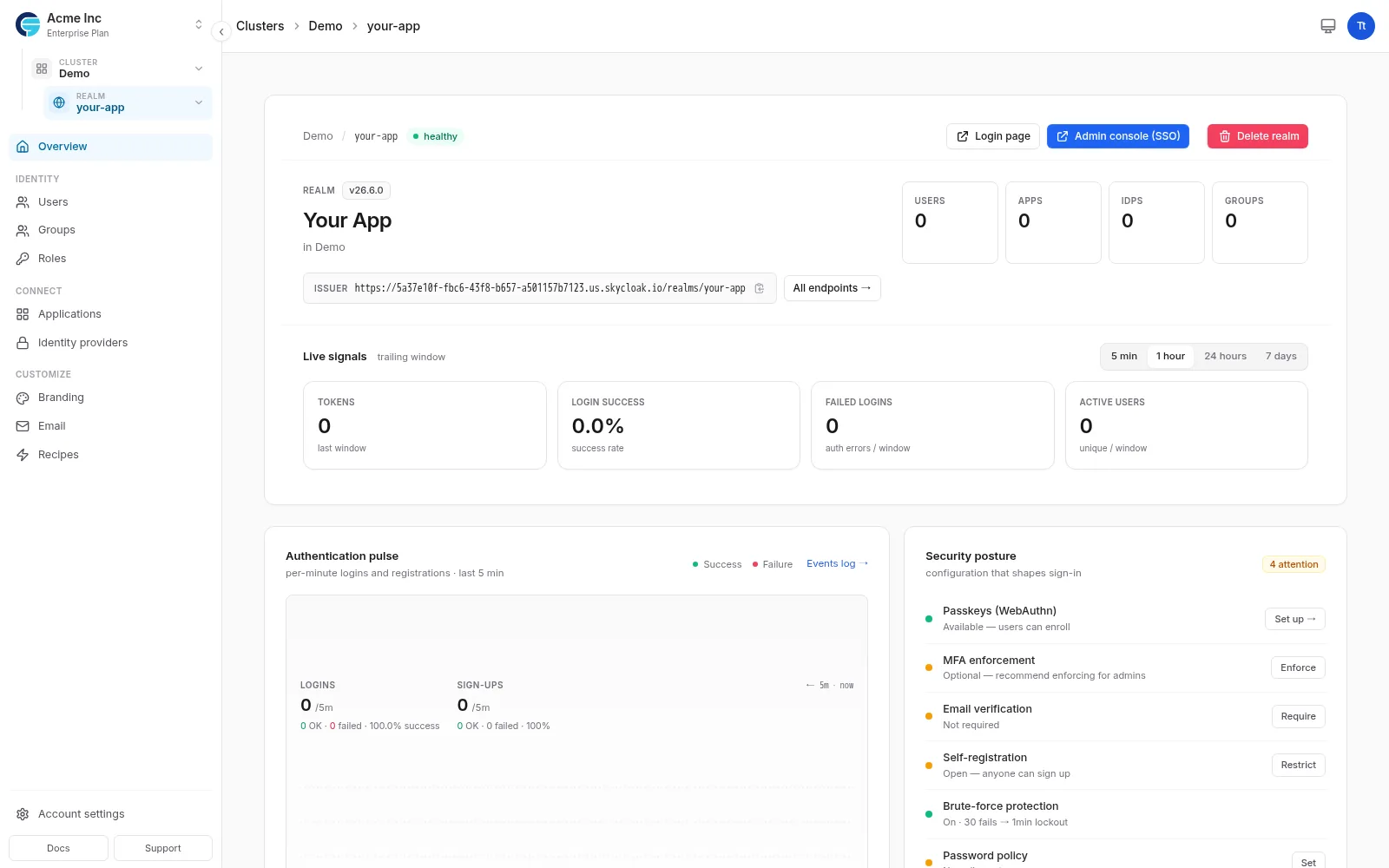
Skycloak is a Keycloak-as-a-Service platform. You create a managed cluster through app.skycloak.io, configure realms and clients like any self-hosted deployment, and point your apps at Skycloak-hosted endpoints. The vendor handles Kubernetes (or equivalent) underneath—patching, failover, backups, monitoring, and version upgrades—while you retain standard Keycloak workflows: themes, identity providers, user federation, SPI extensions on higher tiers, and Terraform/API automation.
The product is deliberately not a simplified auth widget. It is managed infrastructure for teams that want Keycloak's power without hiring a dedicated IAM ops role. Public positioning emphasizes three promises:
- No MAU tax — your bill does not balloon when signups spike.
- No fork — export realms and migrate to self-hosted Keycloak anytime.
- Production-grade SLAs — multi-site clusters, 24/7 monitoring, and contractual uptime on paid tiers.
Customer logos on the site include Scratch and Beaulieu Canada; published testimonials highlight predictable flat pricing as the deciding factor—not flashy UI tricks.
Evaluation methodology
We evaluated Skycloak by reviewing its live marketing site, pricing page, documentation, comparison content, and third-party listings (GetApp, Inteca's managed-Keycloak roundup). We did not run a paid production cluster or load-test failover during this review. Keycloak version numbers on marketing screenshots (26.x) reflect current upstream releases; confirm your cluster version at signup. Competitor pricing for Auth0/Okta is illustrative—vendor list prices change; validate quotes against your MAU and feature mix.
Product overview
Real Keycloak, not a wrapper
Skycloak's most important claim is also its main differentiator: official upstream Keycloak, not a rebranded fork with hidden limitations. That matters for three reasons:
- Your developers can follow standard Keycloak docs, SDKs, and community answers.
- Custom SPIs, themes, and authenticators (Business+ and extension add-ons) behave like self-hosted Keycloak.
- Realm export preserves an exit path—if Skycloak shuts down or prices shift, you are not trapped in a proprietary schema.
For buyers burned by Auth0's pricing model or Okta's enterprise gates, open-source portability is strategic, not philosophical.
Cluster management and regions
The control plane lets you spin up clusters in minutes (docs cite 2–4 minutes for provisioning). Each plan includes a defined cluster count and size tier:
| Plan | Clusters | Default size | Notable infra |
|---|---|---|---|
| Developer ($29/mo) | 1 | Small | 1 custom domain, email support |
| Launch ($149/mo) | 1 | Small; Medium available (+$199/mo) | Team invites, analytics, 4h urgent support |
| Business ($599/mo) | 2 | Medium max | 90-day logs/insights, 1h urgent support, security bundle included |
| Enterprise (custom) | 3+ | Large included | Private Link/VPC, 24/7 CSM, 30-min urgent response |
Region selection covers US, EU (Frankfurt), Canada, Australia, and additional locations—important for GDPR, data-sovereignty, and latency. Multi-site deployments within a region underpin the 99.99% SLA story (automatic failover, 24/7 monitoring).
Authentication features (all plans)
Every tier ships the full Keycloak feature set Skycloak advertises—no "enterprise MFA" upsell games:
- SSO via OIDC/OAuth 2.0 and SAML
- MFA, WebAuthn/passkeys, passwordless flows
- Unlimited social identity providers
- Custom identity brokers and user federation
- RBAC, session management, user profiles
- Application management with setup wizard and enterprise app gallery
If you have configured Keycloak before, the surface area will feel familiar. If you have not, budget onboarding time—or use Skycloak's docs and support channels. This is not Clerk-style five-line integration; it is full IAM.
Developer platform
Skycloak layers SaaS conveniences on top of raw Keycloak:
- Public REST API and API keys (10–100 per plan)
- Terraform provider for infrastructure-as-code teams
- Webhooks for user events (limits scale by plan)
- MCP Server listed as "coming soon" on all tiers—promising for AI-agent workflows, not shippable at time of review
The Terraform + API story is a serious signal for platform engineering teams that treat auth like any other managed service in a GitOps pipeline.
Branding, analytics, and operations
Lower tiers include login-page branding and email templates; Launch removes "Powered by Skycloak" branding. Business adds custom theme upload/download, longer auth event retention (7 → 30 → 90 days), live log tail, and richer insights dashboards. These features matter when auth is customer-facing and compliance asks for audit trails.
Security add-ons
WAF (OWASP CRS), IP access control, rate limiting, geo-blocking, CAPTCHA (Cloudflare Turnstile), and SIEM export (Splunk, Datadog, Elastic, etc.) are paid add-ons on Developer and Launch, included on Business+. If you are exposing a public login endpoint to the internet, treat WAF and rate limiting as mandatory—not optional nice-to-haves. Budget add-on costs on sub-Business plans rather than assuming "managed" means "hardened out of the box."
Extensions and migration
Skycloak supports bring-your-own-extension (upload JARs) and custom extension development by their Keycloak team—useful for exotic authenticators or legacy user stores. Realm import/export and migration assistance are part of the enterprise motion; docs invite teams moving from Auth0, Cognito, Firebase, or another Keycloak host to contact support.
Who should use Skycloak
- Startups outgrowing MAU-based IDaaS where Auth0 or Stytch quotes now dominate the infra budget.
- Teams already standardized on Keycloak that want to stop patching CVEs and managing Postgres backups.
- B2B SaaS with SAML/OIDC requirements and predictable per-tenant user growth (unlimited users removes forecasting anxiety).
- Regulated buyers needing SOC 2 / ISO 27001 posture, regional residency, and SIEM export without building compliance plumbing alone.
- Platform engineers who want Terraform-managed auth clusters alongside the rest of their stack.
Who should wait
- Greenfield apps wanting the fastest "add login" DX—Clerk, Supabase Auth, or Auth0's developer UX may be simpler despite higher long-term cost.
- Teams with a dedicated IAM platform team that already runs HA Keycloak cheaply on Kubernetes—self-hosting stays $0 in license fees if you absorb labor.
- Buyers needing deep Keycloak contributor support for exotic SPI work—Phase Two and enterprise consultancies (Inteca) may fit better.
- EU-sovereign-only strategies where specialized EU hosts (cloud-iam, Clever Cloud) are non-negotiable—Skycloak has EU regions, but compare contractual guarantees carefully.
- Sub-$29 hobby projects—the Developer plan is affordable, but Keycloak itself is heavier than lightweight auth for a side project.
Pricing and value
Skycloak publishes transparent monthly pricing (20% discount on annual billing):
| Plan | Monthly | Annual (effective/mo) | Best for |
|---|---|---|---|
| Developer | $29 | ~$23 | Solo devs, staging, proofs-of-concept |
| Launch | $149 | ~$119 | Growing startups, production with branding |
| Business | $599 | ~$479 | Two clusters, security bundle, longer retention |
| Enterprise | Custom | Custom | Private Link, 24/7 CSM, large clusters |
Every plan includes unlimited users and a 7-day free trial without a credit card. Trials expire cleanly—no surprise charges—which lowers evaluation risk.
Extra costs to model honestly:
- Medium cluster: +$199/mo; Large: +$399/mo
- Additional cluster: from $39/mo (Small) depending on size
- Extra custom domains: $49/mo each beyond plan allowance
- Security add-ons on Developer/Launch: priced à la carte until Business
Skycloak's pricing page illustrates a 50,000 MAU scenario: ~$149/mo on Launch vs ~$1,000–2,500/mo on Stytch/Auth0/Okta list positioning. Your mileage varies—enterprise Auth0 contracts negotiate heavily—but the structural advantage of flat infrastructure pricing is real for high-MAU, low-ARPU products (consumer apps, education platforms, internal tools).
Discount programs: 15% off for nonprofits, EdTech, and early-stage startups (under two years, <$1M funding). GetApp also references a student program—confirm eligibility with sales.
Editorial ratings
These scores reflect Launchpadly's editorial judgment from product research and category fit—not an aggregated user rating unless noted.
| Category | Score |
|---|---|
| Setup & admin UX | 3.5/5 |
| Pricing value | 4.5/5 |
| Security & compliance | 4.5/5 |
| Keycloak fidelity | 4.5/5 |
| Feature depth & ops | 4.5/5 |
| Overall editorial rating | 4.4 / 5 |
Skycloak's public review footprint is smaller than Auth0 or Okta—check GetApp and vendor testimonials for additional buyer perspectives.
Pros and cons
Pros
- Unlimited users eliminates MAU/SSO-tax anxiety—a genuine CFO-friendly differentiator.
- Real upstream Keycloak with export/self-host path—credible anti-lock-in story.
- 99.99% contractual SLA and multi-site failover—appropriate for production login dependencies.
- Strong compliance posture: SOC 2 Type II, ISO 27001, GDPR; HIPAA badge on marketing materials.
- Full feature surface (SAML, MFA, passkeys, social login) on every plan—no artificial enterprise gates for core IAM.
- Terraform provider + API for teams that automate infrastructure.
- 7-day no-card trial on any plan—rare among managed Keycloak hosts.
- Multi-region residency (US, EU, Canada, Australia, etc.) on a single product.
Cons
- Keycloak complexity remains—managed hosting does not simplify realm design or client configuration for newcomers.
- Security hardening costs extra on Developer/Launch—WAF, rate limiting, and SIEM are not default on low tiers.
- Business at $599/mo is fair at scale but steep for early startups needing two environments plus security bundle.
- Smaller public review footprint than Auth0/Okta—fewer independent long-form case studies beyond quoted testimonials.
- MCP Server not yet shipped despite roadmap placement—do not buy on that feature today.
- Add-on math can creep—extra clusters, domains, and Medium/Large sizing add up; use their calculator before committing.
- Not a Red Hat partner—enterprises wanting vendor-backed Keycloak support may prefer consultancies with RH alliances (e.g., Inteca).
Real use cases
A B2B SaaS with 30,000 free users and 2,000 paying seats moves off Auth0 Essentials after renewal doubles. Skycloak Launch at $149/mo covers unlimited MAUs for their freemium funnel; SAML for enterprise customers works out of the box. They run staging on a second Small cluster add-on ($39/mo) instead of a second Auth0 tenant.
A Canadian healthcare-adjacent startup picks a Canada-region cluster for residency, enables Business-tier SIEM export to Datadog, and uses included WAF + rate limiting on the public login endpoint—meeting security questionnaire items without building edge infrastructure.
A platform team already running self-hosted Keycloak on a single VM migrates to Skycloak Developer for production during a hiring freeze, exports realms to validate parity, and keeps a local Keycloak docker compose for offline integration tests—exercising the no-fork promise.
How it compares
The identity market splits into MAU-priced IDaaS (Auth0, Okta, Stytch), managed open-source (Skycloak, Phase Two, cloud-iam, Elestio), and DIY Keycloak.
| Provider | Model | Unlimited users | Best when |
|---|---|---|---|
| Skycloak | Flat infrastructure | Yes (all plans) | Keycloak shops wanting 99.99% SLA + self-serve SaaS |
| Phase Two | Tiered SaaS | Yes | Heavy extensions; contributor-led Keycloak expertise |
| cloud-iam | Plan + user tiers | Varies by plan | EU-sovereign Keycloak specialization |
| Elestio | Hosting + support tiers | Yes | Budget multi-cloud Keycloak hosting |
| Auth0 / Okta | Per MAU/user | No | Mature SDKs, largest integration ecosystems |
| Self-hosted Keycloak | Labor + infra | Yes | You have ops headcount and want $0 license cost |
Skycloak's honest sweet spot is product teams that chose Keycloak for economic or flexibility reasons and now need enterprise operations without re-platforming to proprietary IDaaS. It is less ideal for teams that want auth abstracted away entirely.
Against Auth0/Okta, Skycloak wins on predictable cost at scale and portability; incumbents win on ecosystem size, prebuilt UI components, and vendor familiarity in RFPs.
Against self-hosting, Skycloak wins on time-to-production and SLA; DIY wins if you already operate Kubernetes reliably and treat IAM as core competency.
Against Phase Two and cloud-iam, the choice narrows to pricing shape, region strategy, and extension support depth—run a trial migration on representative realms before deciding.
Verdict
Skycloak delivers a credible answer to a specific, expensive problem: Keycloak's power with someone else on call for upgrades, HA, and compliance evidence. The flat pricing model is not marketing gloss—it changes how finance models growth-stage auth. Unlimited users on a $149 Launch plan is structurally cheaper than MAU-based IDaaS for many real-world SaaS shapes, and the no-fork, export-anytime policy reduces strategic risk in a category famous for lock-in.
We recommend starting with the 7-day trial on Launch (or Developer for non-production), migrating a single non-critical realm, and measuring login latency, admin workflow, and support responsiveness before annual commitment. Upgrade to Business when you need included WAF/rate limiting, 90-day audit logs, and a second cluster for production/staging separation. Talk to Enterprise if Private Link/VPC, dedicated CSM, or custom compliance clauses are on your checklist.
Skip Skycloak if you will never touch Keycloak concepts and want the simplest possible auth API—simpler tools exist. Skip it if your team already runs patched HA Keycloak happily. For everyone else staring at a renewal quote that scales with user count, Skycloak is one of the most straightforward managed Keycloak options in 2026—and worth a disciplined trial if predictable IAM economics matter to your runway.
FAQ
Is Skycloak real Keycloak or a proprietary fork?
Real upstream Keycloak. Skycloak runs the official open-source release with full admin access. You can export realms and self-host on your own infrastructure; there is no proprietary fork or alternate API surface.
Does Skycloak charge per monthly active user?
No. Pricing is based on plan tier, cluster size, and add-ons—not MAU, seat count, or per-SSO-connection fees. Every self-serve plan advertises unlimited users.
How much does Skycloak cost?
Developer starts at $29/mo, Launch at $149/mo, Business at $599/mo, and Enterprise is custom. Annual billing saves 20%. Extra clusters, larger sizes, domains, and security add-ons (on lower tiers) cost more—use Skycloak's pricing calculator for a realistic total.
Is there a free trial?
Yes. Every plan includes a 7-day free trial with no credit card. If you do not upgrade, the trial expires without charges.
What uptime SLA does Skycloak offer?
Up to 99.99% contractual uptime on eligible paid tiers, backed by multi-site deployments and 24/7 monitoring. Exact SLA terms vary by plan—confirm in your agreement, especially on Developer vs Enterprise.
What compliance certifications does Skycloak have?
Skycloak publishes SOC 2 Type II, ISO 27001, and GDPR compliance. Marketing materials also reference HIPAA alignment; validate specific BAA or healthcare requirements with sales if you are in a regulated vertical.
Can I migrate from Auth0, Okta, or self-hosted Keycloak?
Yes, with planning. Skycloak documents realm import/export and offers migration assistance—especially on enterprise engagements. OIDC/SAML apps typically repoint issuer URLs; user password hashes may require migration strategy (often a phased cutover or reset flow). Contact support for complex federation setups.
Which regions are available?
Skycloak supports US, EU (Frankfurt), Canada, Australia, and additional regions per their cluster picker—pin each cluster to the residency your compliance team requires.
Do I get WAF and brute-force protection by default?
Not on all plans. Developer and Launch treat WAF, rate limiting, geo-blocking, CAPTCHA, and SIEM export as add-ons. Business and Enterprise include the security bundle. Budget accordingly for internet-exposed login endpoints.
How does Skycloak compare to Auth0 for a startup?
Auth0 often wins early on developer experience and tutorials; Skycloak wins when user count grows faster than revenue and you want Keycloak-standard protocols without MAU billing. Many teams prototype on Auth0 and migrate to managed Keycloak at renewal—Skycloak targets that second phase.
 Execlave
 CypherKeep
 BackupMonitor.cloud